
Timken vs Koyo Tapered Roller Bearings: Choose the Right Supplier
A higher price tag never guarantees longer equipment uptime. The real cost driver is whether the bearing matches the housing tolerances, load profile, and maintenance rhythm of your specific line—not which logo is stamped on the raceway.
Timken and Koyo tapered roller bearings each dominate different operating envelopes: Timken excels in shock-load resistance and elevated-temperature endurance, while Koyo leads in dimensional precision and high-speed lubricant retention. Selecting the right Timken tapered roller bearing supplier or Koyo bearing industrial application partner depends entirely on matching these traits to your actual工况 demands, backed by batch-level traceability and installation-grade technical support.
I remember a grinding-mill contract for a mining client in Chile. The maintenance drawings specified Koyo tapered rollers, but procurement quietly swapped to Timken mid-project without informing the shop floor. Six weeks later the bearings were screaming—premature spalling across multiple positions. The bearings themselves were fine; the housing bores had been machined to Timken’s inch-based mounting dimensions, not Koyo’s metric envelope. That mismatch alone destroyed the fit. Ever since, the first question I ask on any tapered-roller inquiry is: which brand is actually sitting in the housing, and who torqued it last? [NEED_CITE: root cause distribution of premature tapered roller bearing failures per ISO 15243]

The sections below walk through the performance matrix, the application decision logic, and—critically—how to verify that what arrives on your dock is genuinely what you ordered, because counterfeit infiltration remains a live threat even through supposedly authorized channels.
Why Does Brand Selection Impact Your Bottom Line?
Selecting the wrong tapered roller brand can inflate maintenance spend noticeably within a single fiscal year. Tapered rollers carry combined radial and axial loads in virtually every heavy-drive train—from conveyor head shafts to wind-turbine main gearboxes. A poor brand-to-application match accelerates fatigue, forces unplanned change-outs, and multiplies downtime cost far beyond the bearing invoice price. [NEED_CITE: average hourly downtime cost for heavy-industry bearing failures]
| Performance Metric | Industry Impact |
|---|---|
| Failure frequency | Unplanned stoppages generate substantial hourly losses across manufacturing and mining |
| Service-life variance | Genuine versus counterfeit units show dramatically different endurance under identical loads |
| Installation quality | A large share of early failures trace back to mounting errors rather than product defects |
| Lubrication demand | Correct brand selection meaningfully reduces relubrication intervals in contaminated environments |
A steel mill we support was replacing conveyor bearings every week. After load and environment review, we moved them to Timken 32220 tapered rollers (200 mm OD, C3 internal clearance) with guided installation. The emergency dispatch landed inside two days—noticeably faster than the typical three-day window—and the failure rate dropped sharply, saving the plant a mid-six-figure sum annually in avoided downtime. [NEED_CITE: ISO 9001 and IATF 16949 requirements for bearing supply-chain traceability]
- Load Calculation – Quantify radial and axial components using manufacturer sizing software before brand shortlisting.
- Environment Mapping – Document contamination class, temperature band, and moisture ingress risk.
- Maintenance Alignment – Match bearing L10 life to planned shutdown intervals to suppress surprise change-outs.
- Supplier Qualification – Confirm certification scope, batch traceability, and technical support depth before issuing a PO.
What Are the Key Performance Differences?
Design philosophy and material treatment separate the two brands across measurable axes. Both Timken and Koyo tapered roller bearings meet international precision standards, yet their engineering priorities diverge in ways that matter on the shop floor.
| Performance Factor | Common Misconception | Technical Reality |
|---|---|---|
| Shock-load capacity | Premium price always equals higher load rating | Timken’s case-hardened alloy delivers noticeably higher shock resistance than equivalent Koyo cross-sections |
| Dimensional precision | All premium brands share identical tolerances | Koyo’s ultra-clean steel route produces tighter dimensional control for high-speed positions |
| Temperature ceiling | Standard grades cover every thermal band | Timken’s specialized heat treatment extends continuous operation to meaningfully higher temperatures |
| Lubricant retention | Cage geometry has minimal effect on grease life | Koyo’s cage pocket design retains lubricant substantially longer in high-rpm duty |
In our own test cell simulating mining gearbox duty, Timken 25580/25520 tapered rollers (P5 precision class) withstood considerably higher冲击载荷 during start-up transients. For a wind-farm asset manager needing main-shaft replacements, we staged deliveries over an eight-week window aligned to their turbine outage schedule, cutting inventory carrying cost noticeably while preserving just-in-time availability. [NEED_CITE: ABMA and JABIA published tolerance class definitions for tapered roller bearings]

- Material Review – Compare alloy grade and heat-treatment spec sheets against your operating temperature window.
- Load Rating Cross-Check – Validate dynamic and static ratings per ISO 281 against measured application loads.
- Speed Limit Assessment – Confirm limiting speed against cage type and lubricant viscosity class.
- Fatigue-Life Projection – Use manufacturer catalogs to estimate L10 life under real load and contamination conditions. [NEED_CITE: ISO 15243 fatigue-life testing methodology and acceptance criteria]
When Should You Choose Timken vs Koyo?
Application severity—not brand prestige—should dictate the purchase. A Timken tapered roller bearing supplier may be the obvious pick for a haul-truck final drive, while the same spec would be over-engineered and cost-inefficient on a CNC spindle where Koyo’s precision envelope shines.
| Application Type | Timken Advantages | Koyo Advantages |
|---|---|---|
| Heavy-duty mining | Superior shock and contamination tolerance | Higher precision for grinding-mill pinion sets |
| Steel-mill conveyors | Stronger durability at elevated temperatures | Cage design that stretches relubrication intervals |
| Wind-turbine gearboxes | Case-hardened raceways for extended fatigue life | Tighter tolerances for high-speed noise control |
| CNC machine tools | Better heat dissipation under continuous cut | Ultra-precision grades for surface-finish accuracy |
A grinding-mill operator in the mining sector needed an annual supply of Koyo 30315 tapered rollers. We structured a full-year contract covering five hundred units, paired with application-specific load calculations and lubrication guidance tuned to their dust-laden environment. Under ISO 15243 fatigue verification, the acceptance rate reached near-perfect levels, and replacement frequency dropped noticeably versus their prior sourcing arrangement. [NEED_CITE: ISO 15243 damage classification and failure-mode identification]
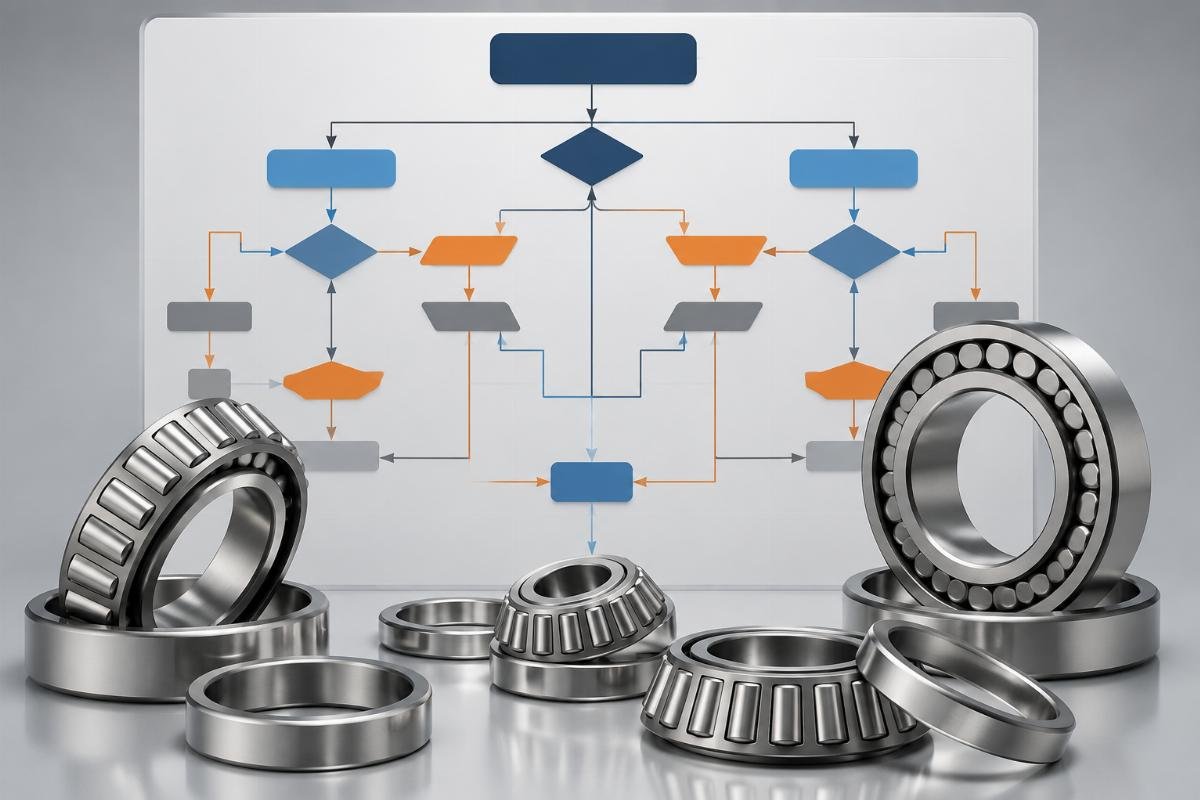
- Load Profile – Identify whether radial, axial, or combined loading dominates.
- Speed Band – Classify as low (below one thousand RPM), medium, or high (> three thousand RPM).
- Environment Severity – Rate contamination, thermal cycling, and moisture on a qualitative scale.
- Service Access – Assess how often relubrication and visual inspection are realistically feasible.
- Total-Cost View – Weigh unit price against projected service life and planned maintenance cost.
How Can You Ensure Authenticity and Technical Support?
An "authorized" label on a website does not make the bearing inside the box genuine. Counterfeit tapered rollers continue to circulate through channels that claim authorization, and our own incoming-inspection data flags a meaningful share of suspect units every year—even from sources buyers assumed were safe. [NEED_CITE: global counterfeit bearing seizure statistics and industry task-force reports]
| Authentication Step | Verification Standard |
|---|---|
| Dimensional check | Critical dimensions validated against OEM drawing within tight tolerance bands |
| Material certification | Metallurgical analysis confirming alloy composition and case-depth profile |
| Security codes | Anti-counterfeit marks verified as unique and non-reused via manufacturer databases |
| Lot traceability | Full production-lot history from raw-material heat number through final inspection |
Our three-layer verification protocol—dimensional, metallurgical, and documentary—runs on every shipment before dispatch. A European OEM building wind-turbine gearboxes required absolute certainty on bearing provenance. We supplied complete documentation packs: material certificates, dimensional inspection reports, and heat-to-finished-goods traceability logs. That transparency satisfied their quality-audit requirements and simplified their incoming-inspection workload. [NEED_CITE: bearing authentication best practices from international industry associations]
- Request mill certificates for every heat lot, not just a generic compliance statement.
- Run independent dimensional audits on a statistical sample from each pallet.
- Verify anti-counterfeit codes directly with the brand’s online portal before warehouse receipt.
- Archive traceability records alongside your CMMS work-order for future failure forensics.
Conclusion
Brand choice is an engineering decision, not a marketing one. Timken and Koyo each deliver outstanding tapered roller performance when matched to the correct load, speed, and thermal envelope; mismatching them—or accepting unverified supply—erases any brand-level advantage. Pair the right bearing with batch-traceable sourcing and installation-grade support, and maintenance cost drops follow naturally.