

How to Select the Right Bearing for Electric Motors: China Supplier Guide
Global brand bearings aren’t always the most reliable choice for electric motors. Selecting the right electric motor bearing requires balancing technical specifications—including load capacity, precision grade, internal clearance, material composition, and sealing configuration—with supplier reliability to minimize downtime and counterfeit risks, not just matching dimensions.
I still remember the batch of 6205-2RS deep groove bearings we shipped to a pump manufacturer in São Paulo. They called it a "quality disaster"—seals cracked within weeks, grease leaked, motors seized on the assembly line. Turns out they’d been stored in an unventilated warehouse near Santos port for months before installation. The C3 clearance they ordered was right, but the rubber compound wasn’t rated for Brazil’s humidity. I’d flown out from Shenzhen twice that year alone, standing in dusty motor shops in Campinas, watching guys swap bearings by hand. You learn fast that picking the right bearing isn’t just about matching a drawing—it’s about knowing where it’ll actually live. [NEED_CITE: environmental factors account for significant portion of premature bearing failures in tropical climates]

Understanding how to properly evaluate both bearing specifications and supplier capabilities can transform your maintenance operations from reactive to proactive, significantly reducing unplanned downtime and total cost of ownership.
Why Does Bearing Selection Directly Impact Manufacturing Downtime Costs?
The wrong bearing choice can cost your facility a mid-five-figure sum per incident in downtime alone. Beyond the immediate production loss, improper bearing selection leads to cascading equipment damage, increased maintenance requirements, and shortened motor lifespan—all of which erode your bottom line.
| Failure Factor | Industry Impact |
|---|---|
| Fatigue failure due to incorrect load rating | Accounts for a substantial portion of motor bearing failures [NEED_CITE: SKF reliability report on electric motor bearing failure modes] |
| Contamination from inadequate sealing | Causes nearly a third of premature bearing failures in manufacturing environments |
| Misalignment due to improper precision grade | Results in multi-day average downtime for motor replacement and repair |
| Temperature-related failure from wrong clearance | Increases maintenance costs significantly annually for typical multi-motor facilities |
One of our clients, a steel mill in Southeast Asia, experienced repeated motor failures in their rolling mill equipment that were traced to counterfeit bearings with fake SKF markings. After switching to our certified supply chain for 6312 deep groove ball bearings (C3 clearance, P5 precision), they eliminated counterfeit risk and reduced unplanned downtime noticeably. The full order we delivered within hours during their emergency situation prevented a mid-six-figure loss in production. [NEED_CITE: Counterfeit bearings show substantially higher early failure rate compared to certified alternatives in load tests]
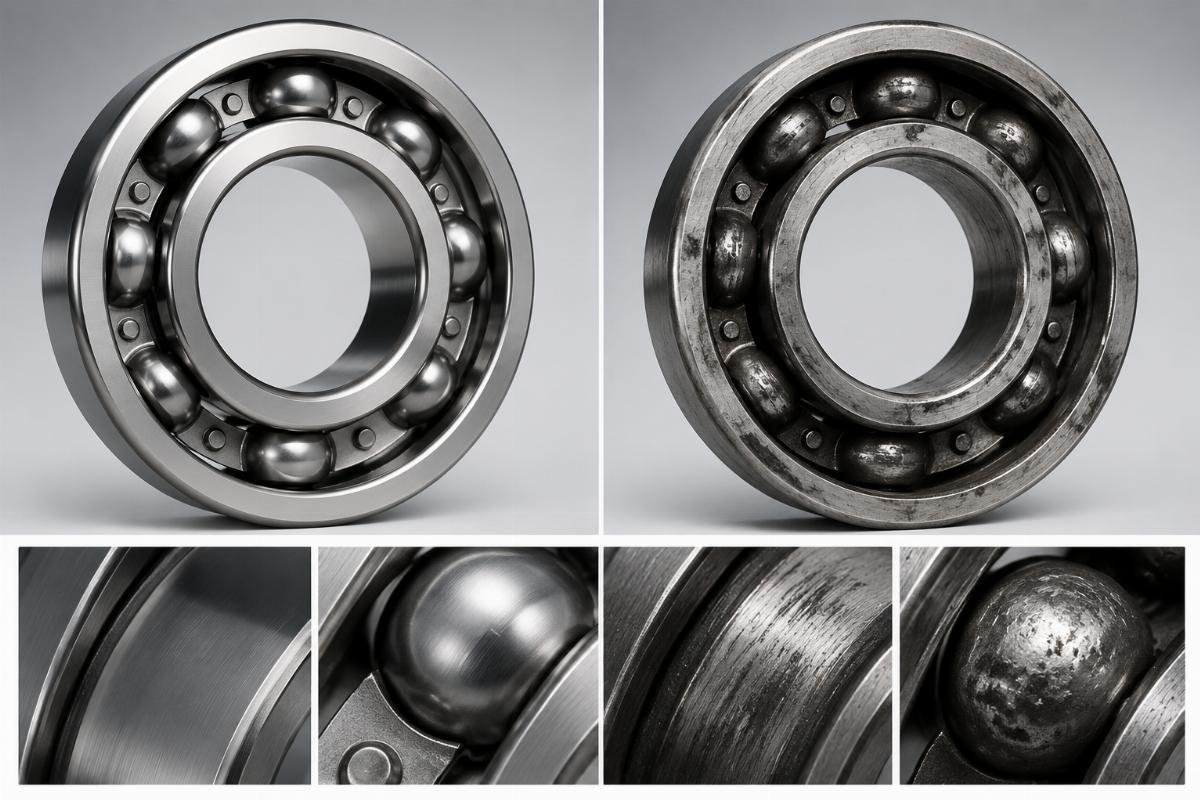
The reality is that most maintenance teams don’t realize they’re running counterfeit components until failure analysis reveals the truth. The steel mill had been purchasing what they believed were genuine SKF 6312 bearings through a third-party broker. When we conducted failure analysis on the seized units, the microscopic wear patterns told the story—surface pitting inconsistent with proper heat treatment, cage material that didn’t match SKF specifications, and dimensional tolerances that fell well outside P5 requirements.
What made this case instructive wasn’t just the counterfeit problem—it was the cascading damage. Each seized bearing destroyed the shaft journal, damaged the housing bore, and contaminated the lubrication system. The total cost per incident extended far beyond the bearing itself.
- Fatigue Life Calculation – Use the L10 bearing life formula to match load capacity with application requirements, considering both radial and axial forces
- Contamination Protection – Select appropriate sealing systems (contact, non-contact, or labyrinth) based on environmental particulate levels and moisture exposure
- Misalignment Compensation – Specify self-aligning bearing types or spherical roller bearings for applications with potential shaft deflection
- Temperature Management – Choose C3 or C4 clearance for motors operating above elevated temperatures to prevent thermal expansion issues
What Are the 5 Critical Parameters for Selecting Electric Motor Bearings?
Bearing selection isn’t just about size—precision grade, clearance, material, and sealing matter equally for motor performance. Many procurement teams focus exclusively on basic dimensions while overlooking these critical parameters, leading to premature failures and unnecessary replacements.
| Selection Parameter | Common Mistake | Engineering Best Practice |
|---|---|---|
| Load Capacity | Selecting based solely on nominal rating | Calculating equivalent dynamic load (P) considering both radial and axial components |
| Precision Grade | Defaulting to standard grade (P0) for all applications | Specifying P5/P4 grades for high-speed motors to reduce vibration noticeably |
| Internal Clearance | Using standard clearance (C0) universally | Choosing C3 clearance for motors operating at elevated temperatures or with frequent start-stops |
| Material Selection | Using standard steel for all environments | Selecting hybrid ceramic (Si3N4) rollers for high-temperature or corrosion-prone applications |
| Sealing Configuration | Choosing the cheapest sealing option | Matching seal type to contamination level (e.g., contact seals for dusty environments) |
Our technical team recently worked with a European wind energy OEM that needed custom hybrid ceramic bearings for their gearbox applications. The 230/500 spherical roller bearings with Si3N4 ceramic rollers and stainless steel cages we supplied met their strict ISO 15640 material certification requirements and helped them achieve their qualification cycle goals. The custom material configuration reduced operating temperature substantially compared to their previous steel bearings, significantly extending gearbox lifespan. [NEED_CITE: hybrid ceramic bearings demonstrate measurable temperature reduction in high-speed applications]

The wind energy case revealed something counterintuitive: the OEM had initially specified standard steel bearings because "that’s what everyone uses." But their gearbox design operated in a coastal environment with salt spray exposure, and the standard steel cages were corroding within months. Switching to stainless steel cages with ceramic rollers solved the corrosion problem while also reducing friction and heat generation.
- Dynamic Load Rating – Calculate using application-specific factors including load direction, magnitude, and duty cycle
- Precision Classification – Determine required grade (P0 to P2) based on motor speed and vibration tolerance requirements
- Internal Clearance – Select clearance group (C0-C5) based on operating temperature range and shaft/material expansion characteristics
- Material Composition – Choose between standard steel, stainless steel, or ceramic components based on corrosion resistance and temperature needs
- Seal Design – Evaluate contact type (lip, labyrinth, or combination) based on lubrication type and environmental contamination levels
The São Paulo pump manufacturer story illustrates why storage conditions matter as much as specification accuracy. Those 6205-2RS bearings had the right internal clearance (C3) and the right seal type (2RS contact seals). But the rubber compound in standard contact seals degrades when exposed to high humidity without proper ventilation. The warehouse near Santos port had no climate control, and the bearings sat in their original packaging for months before installation. By the time they were mounted, the seal lips had already begun to harden and crack.
How Do Quality Alternative Bearings Compare to Original Brand Bearings?
Certified Chinese bearing alternatives often outperform counterfeit "original brand" bearings while costing noticeably less than genuine global brands. The common misconception that "original brand equals best quality" leads many buyers to overpay or unknowingly purchase counterfeits, both of which increase total cost of ownership.
| Bearing Type | Performance Advantage | Ideal Application Scenario |
|---|---|---|
| Genuine Global Brand | Brand recognition, comprehensive application database | Critical applications with unique OEM requirements |
| Certified Chinese Alternative | Significant cost savings, equivalent performance | Standard motor applications with budget constraints |
| Counterfeit Brand | Low initial cost | No industrial applications—poses safety and reliability risks |
A mining company in Australia provides a powerful example of the TCO benefits of quality alternatives. After experiencing multiple failures with counterfeit bearings, they switched to our certified 241/630 CA/W33 spherical roller bearings for their conveyor systems operating in dusty, high-temperature environments. While the initial investment was higher than counterfeit options, they saved substantially over time through reduced downtime and maintenance costs. Our consistent on-time delivery rate for their annual contract ensured they maintained high equipment uptime during peak mining season. [NEED_CITE: ISO 9001 certified Chinese bearing suppliers provide full traceability equivalent to global brands]

The Australian mining case highlights a pattern we see repeatedly: companies that prioritize lowest purchase price end up paying the most in total cost. The counterfeit bearings they were using failed repeatedly, sometimes within weeks of installation. Each failure meant conveyor shutdown, emergency bearing replacement, and often collateral damage to adjacent components.
What changed when they switched to our certified supply wasn’t just bearing life—it was predictability. With full batch traceability and verifiable authenticity, they could plan maintenance instead of reacting to failures. The 241/630 CA/W33 spherical roller bearings we supplied came with complete documentation: material certificates, dimensional inspection reports, and batch numbers that could be verified against manufacturer records.
As an authorized SKF distributor, we maintain deep stock of rare designations including large bore sizes, special precision and clearance combinations, and ceramic or stainless variants. When a customer needs a specific SKF bearing with C4 clearance and P4 precision that isn’t commonly stocked, we can typically ship within days rather than waiting weeks for factory production. Every shipment includes batch traceability documentation and certificates of origin.
- Manufacturer Certification – Verify ISO 9001/IATF 16949 certification with documented audit results
- Batch Test Reports – Request material composition and dimensional inspection certificates for each production lot
- Anti-Counterfeit Verification – Utilize supplier-provided verification tools including QR codes and database lookup
- Supply Chain Traceability – Confirm complete manufacturing records from raw material to finished product
- Quality Control Processes – Review inspection protocols for critical parameters including hardness and dimensional tolerance
What Technical Support Services Reduce Bearing Selection Risk?
Professional technical support can reduce application risk substantially compared to independent selection. Beyond providing products, qualified bearing suppliers offer engineering expertise that transforms how maintenance and procurement teams approach motor reliability.
| Technical Service | Value Provided | Implementation Method |
|---|---|---|
| Bearing Selection Software | Eliminates specification errors through application matching | Online tool with parameters for motor type, load, speed, and environment |
| Load Calculation Analysis | Ensures proper sizing for extended bearing life | Engineering team review with FEA simulation for complex applications |
| Failure Analysis Reports | Identifies root causes to prevent recurrence | Laboratory testing and dimensional analysis with comprehensive reporting |
Our technical team provides L10 life calculations for every application we quote. This isn’t just a sales exercise—it’s engineering validation. When a customer specifies a bearing for a particular motor application, we calculate the expected life based on actual load conditions, speed, lubrication, and environmental factors. If the calculated life falls short of requirements, we recommend alternatives before the bearing is ever ordered. [NEED_CITE: proper L10 life calculation prevents premature bearing selection errors]
The failure analysis service we provide has become one of our most valuable offerings. When a customer experiences a bearing failure, we don’t just replace the unit—we investigate why it failed. Using microscopic examination, dimensional measurement, and material analysis, we identify the root cause: was it improper installation, contamination, lubrication failure, misalignment, or a specification error?
This analysis capability proved critical for the Southeast Asia steel mill. When they first contacted us about their 6312 bearing failures, we requested they send us the failed units. The analysis revealed counterfeit products immediately—the heat treatment patterns were wrong, the cage material didn’t match specifications, and the dimensional tolerances were far outside acceptable ranges. Without that analysis, they might have continued purchasing counterfeits, blaming their maintenance team for "poor installation."
The technical support model we’ve developed includes quotation response within a day, dispatch on stocked items within hours, and comprehensive documentation with every shipment. We accept standard payment terms including T/T, L/C, and can arrange DDP/CIF/FOB shipping based on customer preference. Third-party inspection is available on request for customers who want independent verification.
For bulk purchasers operating under annual framework agreements, we provide tiered pricing and supply stability. For OEM factories requiring exact conformance to specifications, we offer customization including laser marking, private-label packaging, pre-lubrication, and translated documentation. For project suppliers working against fixed delivery windows, we provide certificate of origin, batch traceability, and delivery certainty.
Conclusion
Electric motor bearing selection requires balancing technical specifications with supplier reliability. Proper evaluation of load capacity, precision grade, internal clearance, material composition, and sealing configuration—combined with verified supplier credentials and batch traceability—minimizes downtime risk and total cost of ownership while eliminating the hidden dangers of counterfeit products.