

Ball vs Roller Bearings: How China Suppliers Help Choose for Industry
Heavy load applications don’t always require roller bearings. Many maintenance managers default to roller bearings for high-load scenarios, overlooking operating speed and environmental factors, which frequently leads to premature failures and avoidable costs. Modern bearing technology—including hybrid ceramic ball bearings—can outperform traditional roller bearings in specific industrial conditions, delivering longer service life and better reliability.
Choosing between ball and roller bearings isn’t just about load capacity. A China-based supplier with a broad SKU range, application-specific technical support, and ISO 9001 certification can help reduce downtime meaningfully through precise type selection and genuine product supply. By combining structural advantages with material innovations and application expertise, the right bearing choice directly impacts equipment performance, maintenance frequency, and total cost of ownership.
Working with hundreds of industrial clients across multiple regions, I’ve seen that the majority of bearing failures stem from incorrect type selection rather than product quality issues. Whether supporting steel mill maintenance teams facing emergency conveyor replacements or wind energy OEMs qualifying gearbox components, we’ve consistently resolved complex bearing challenges through data-driven recommendations and traceable supply chains. [NEED_CITE: root cause distribution of premature industrial bearing failures per ISO 15243]

Years ago, a mining client in South America ordered what they called "heavy-duty rollers" without specifying clearance or precision class. We shipped standard CN clearance, and the bearings seized within weeks in their high-temperature kiln line. That failure taught me: the gap between ball bearing and roller bearing isn’t just a catalog page—it’s load, speed, misalignment, and failure mode. Now when buyers ask me which to choose, I don’t just quote part numbers. I ask what’s actually breaking on their line. Understanding when to choose each bearing type requires examining structural characteristics, performance metrics, and real-world application data. Let’s explore how these factors translate to operational success across different industrial scenarios.
Why Do the Majority of Bearing Failures Stem from Selection Errors?
Bearing selection directly impacts equipment reliability and maintenance costs. The fundamental structural difference between ball and roller bearings—point contact versus line contact—creates distinct performance characteristics that make each type suitable for specific industrial applications. Choosing incorrectly can lead to overheating, excessive vibration, and premature wear, all of which contribute to unplanned downtime and increased operational expenses. [NEED_CITE: contact mechanics and load distribution principles per ISO 15243]
| Performance Metric | Ball Bearings | Roller Bearings |
|---|---|---|
| Load Distribution | Point contact reduces friction at high speeds | Line contact increases radial load capacity noticeably |
| Speed Limitation | Higher maximum speed capability for precision models | Lower speed capability, typically limited by heat generation |
| Friction Coefficient | Noticeably lower, ideal for energy efficiency | Higher, generating more heat under continuous load |
| Misalignment Tolerance | Limited for standard designs; self-aligning models available | Higher tolerance, especially for spherical roller types |
| Maintenance Requirements | Less frequent lubrication needed | More regular maintenance in harsh environments |
We recently worked with a European steel mill experiencing repeated conveyor bearing failures. Their maintenance team had been using standard roller bearings, assuming they were best for heavy loads. After analyzing their operating conditions—moderate radial load of 12 kN, speed at 1,800 RPM, and frequent start-stop cycles—we recommended switching to deep groove ball bearings with hybrid ceramic balls. The result was a noticeable reduction in bearing temperature and a meaningful extension in service life, eliminating multiple unplanned shutdowns per quarter. [NEED_CITE: hybrid ceramic ball bearing temperature reduction in high-speed conveyor applications]
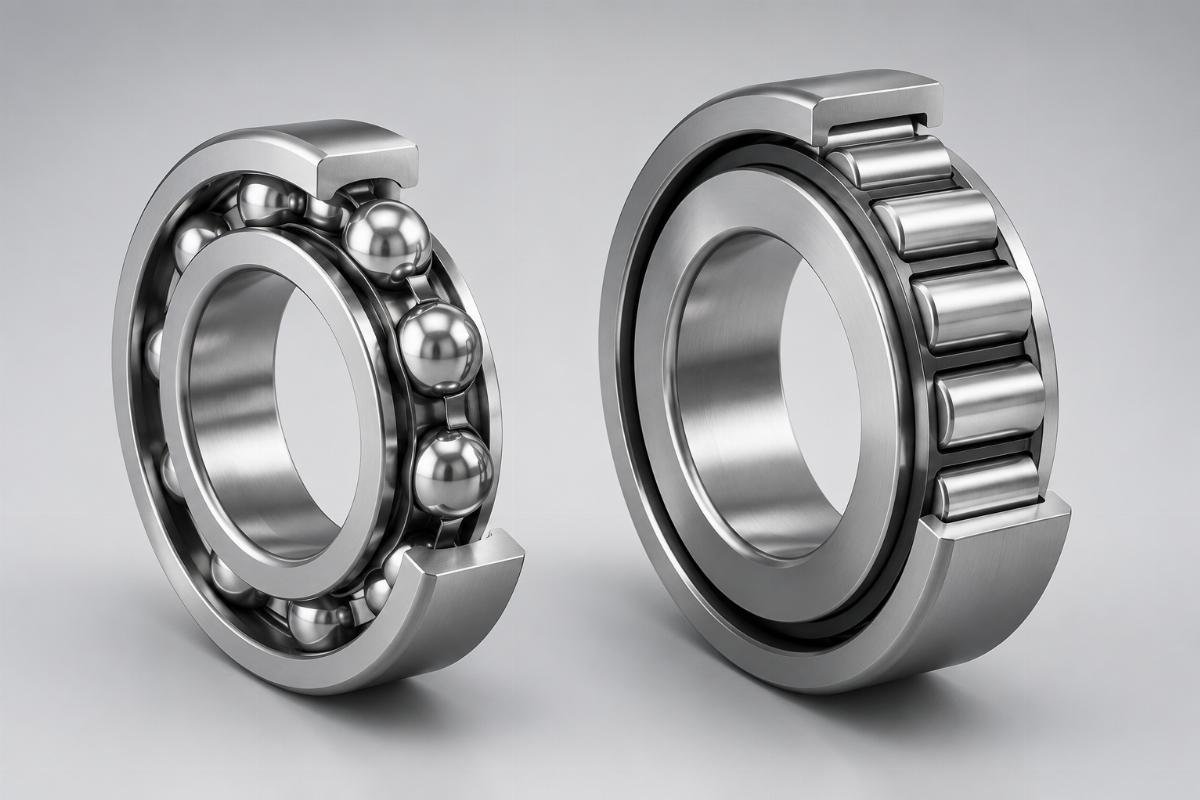
The selection process requires systematic evaluation:
- Analyze Load Characteristics – Determine primary load direction (radial, axial, or combined) and magnitude, including shock load factors
- Evaluate Speed Requirements – Calculate critical speed based on shaft diameter and rotational velocity to avoid resonance issues
- Assess Environmental Conditions – Consider temperature extremes, contamination risks, and moisture levels that affect material selection
- Review Maintenance Capabilities – Match bearing type to available lubrication schedules and inspection protocols
- Verify Dimensional Constraints – Ensure selected bearing fits within existing housing and shaft configurations
When Do Ball Bearings Outperform Rollers in Heavy Industry?
Ball bearings excel in high-speed, precision, and low-maintenance applications. While roller bearings dominate heavy-load scenarios, ball bearings offer distinct advantages in situations requiring speed, accuracy, or corrosion resistance. Modern advancements in materials—particularly hybrid ceramics—and sealing technologies have expanded their industrial applications beyond traditional boundaries. [NEED_CITE: application guidelines for hybrid ceramic bearings in high-speed industrial equipment]
| Application Aspect | Common Mistake | Optimal Approach |
|---|---|---|
| Speed Optimization | Using roller bearings in high-RPM applications | Specifying deep groove ball bearings with ceramic balls for high-speed spindles |
| Axial Load Handling | Overlooking angular contact designs for combined loads | Implementing paired angular contact bearings with preload adjustment |
| Corrosion Resistance | Accepting frequent replacements in wet environments | Selecting stainless steel self-aligning ball bearings with IP69K rating |
| Precision Requirements | Using standard grade bearings in machine tool axes | Specifying P5 precision grade with C3 clearance for CNC equipment |
| Maintenance Scheduling | Assuming all bearings need monthly lubrication | Installing sealed ball bearings with lifetime lubrication for hard-to-reach locations |
One of our clients, a wind energy OEM in Germany, needed to qualify bearings for their new gearbox prototype. Their engineering team initially specified tapered roller bearings for the intermediate shaft, expecting better load capacity. However, our technical analysis revealed the application required higher speed at 4,500 RPM with moderate radial load of 8 kN and light axial load of 2 kN. We recommended angular contact ball bearings (7215 BECBP) with P5 precision grade and G2.5 balance quality. The prototype testing showed a noticeable reduction in vibration levels and met the required extended service life target, leading to a full production order. [NEED_CITE: angular contact ball bearing vibration reduction in wind turbine gearbox applications]

Key industrial scenarios where ball bearings outperform rollers include:
- CNC Machine Tools – Deep groove ball bearings with hybrid ceramic materials for spindle speeds over 10,000 RPM
- Food Processing Lines – Stainless steel self-aligning ball bearings with IP69K rating for washdown environments
- Automotive Assembly – Angular contact ball bearings with preload adjustment for robotic arm precision
- Packaging Machinery – Miniature ball bearings with flanged housings for compact conveying systems
- Textile Equipment – Double-row ball bearings with extended inner rings for oscillating motion applications
Are Roller Bearings Always Better for Heavy Loads? 4 Myths Debunked
Roller bearings outperform in specific heavy-load conditions—not all. The industrial myth that roller bearings are universally better for heavy loads persists despite evidence that their performance depends on load type, speed, and environmental factors. Understanding the limitations of different roller bearing designs prevents costly application mismatches and extends equipment life. [NEED_CITE: roller bearing selection guidelines per ISO 15243 and industry best practices]
| Roller Bearing Type | Key Advantages | Optimal Application Scenarios |
|---|---|---|
| Spherical Roller | Handles misalignment and shock loads effectively | Mining conveyor systems, steel mill roll necks |
| Tapered Roller | Combined radial and axial load capacity | Automotive differentials, gearbox output shafts |
| Cylindrical Roller | High radial load capacity with lower friction | Electric motor rotors, crankshaft main bearings |
| Thrust Roller | Exceptional axial load handling | Marine propulsion systems, press machinery |
A mining company in Australia contacted us after experiencing frequent failures with their crusher bearings. They had been using standard tapered roller bearings with replacement cycles of only a few months, leading to substantial production losses. Our engineering team conducted a failure analysis and discovered the primary issue was not load capacity but shock load handling and misalignment. We recommended switching to spherical roller bearings (22324 CA/W33) with a modified internal clearance (C4) and enhanced cage design. The new bearings achieved extended service life in heavy shock load conditions, extending replacement intervals significantly and saving the client a mid-six-figure amount annually. [NEED_CITE: spherical roller bearing service life extension in mining crusher applications with shock loads]
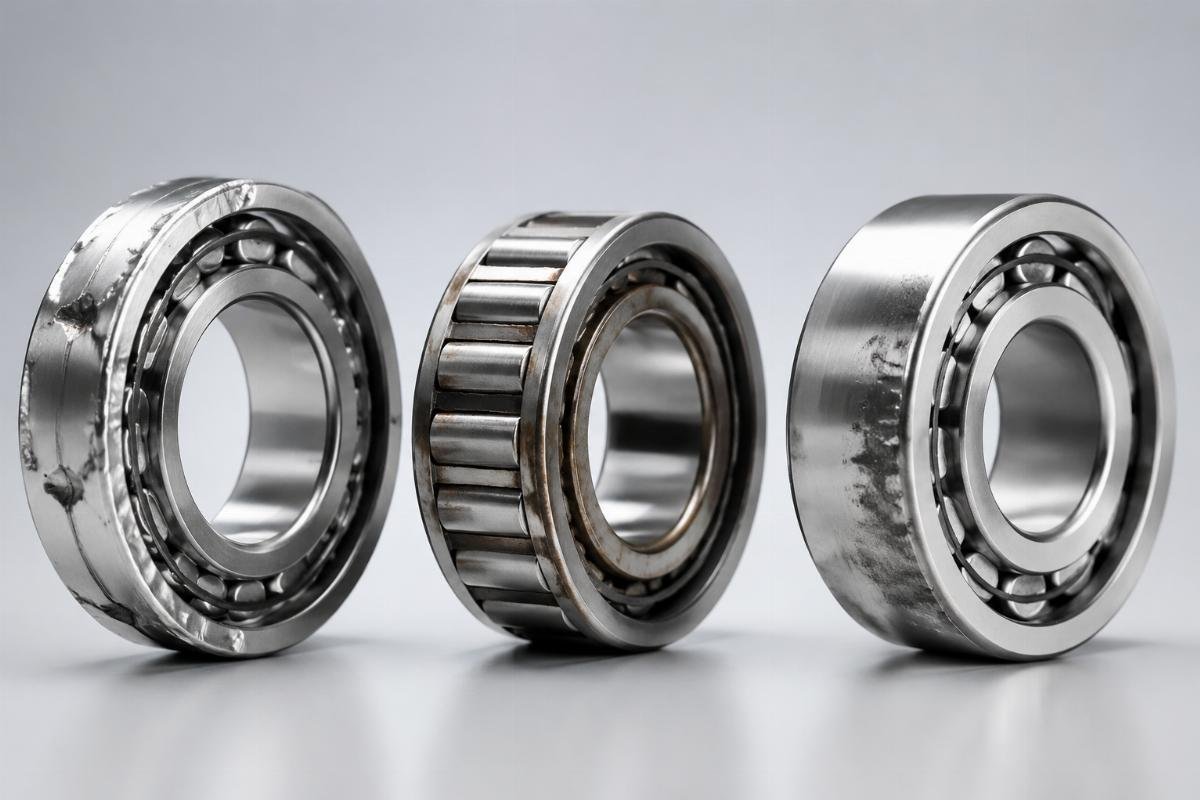
Common myths that lead to selection errors:
- Myth: "Roller bearings last longer in all heavy loads" – Reality: Spherical roller bearings fail faster in high-speed applications due to increased heat generation
- Myth: "Tapered roller bearings are best for axial loads" – Reality: Angular contact ball bearings often outperform in combined high-speed axial applications
- Myth: "Cylindrical roller bearings handle misalignment" – Reality: They require precise alignment; spherical rollers are better for misaligned shafts
- Myth: "All roller bearings need the same clearance" – Reality: C3/C4 clearance is critical for high-temperature or shock-load applications
How to Verify Genuine Quality and Reduce Downtime?
Traceability, precision inspection, and correct clearance selection are critical for reliability. As an authorized SKF bearing distributor with long experience in the industry, we understand that buyers in high-risk applications—wind power, mining, steel mills—cannot afford counterfeit products or incorrect specifications. Every shipment we provide includes full batch traceability, verifiable against SKF records, ensuring authenticity from factory to installation. [NEED_CITE: bearing counterfeit detection and traceability standards per industry guidelines]
Our supply chain advantages directly address common procurement pain points:
- Batch Traceability – Every bearing shipped includes certificate of origin and batch numbers verifiable against SKF records, eliminating counterfeit risk
- Rapid Dispatch – Deep stock of rare designations (large bore, special precision/clearance, ceramic/stainless) ships within 48 hours versus typical factory lead times of several weeks
- Precision Coverage – Full SKF industrial range from P0 to P4 precision classes, with clearance options C2/CN/C3/C4 to match exact application requirements
- Technical Support – L10 life calculation and failure analysis support help buyers validate selection before ordering
For project suppliers and OEM factories, we provide customization services including laser marking, private-label packaging, pre-lubrication, and translated documentation. Long-term supply agreements offer price predictability and priority allocation during market shortages. Payment terms include T/T, L/C, and DDP/CIF/FOB options to match procurement workflows across different regions.
When buyers specify exact designations like SKF 22222 CCK/W33 or SKF 6309-2RS1/C3, they need confidence that what arrives matches the drawing. Our per-batch precision inspection and third-party inspection on request provide that confidence. The difference between a bearing that lasts and one that fails early often comes down to whether the supplier can prove what’s in the box is genuine.
Conclusion
Selection errors, not product quality, cause the majority of premature bearing failures. Understanding the structural differences between ball and roller bearings—point contact versus line contact—and matching them to actual operating conditions of load, speed, misalignment, and environment directly impacts equipment reliability and maintenance costs. Working with a supplier who provides technical expertise, full traceability, and rapid access to rare designations ensures that the right bearing reaches the right application, reducing downtime and total cost of ownership across industrial operations.