

Lubricate Industrial Bearings for Longer Life: China Supplier Guide
Thicker lubricants don’t always mean better protection. In fact, reaching for the highest viscosity grease available can suffocate high-speed bearings, generating excess heat and accelerating seal degradation. The correct approach to industrial bearing lubrication hinges on matching viscosity to speed and load rather than defaulting to heavy-duty assumptions, supported by genuine components and traceable supply chains. When executed properly, correct lubrication extends bearing service life by 30-50 percent and dramatically cuts unplanned downtime across mining, steel, and wind energy operations.
I spent years chasing after-sales calls on wind turbine gearboxes across Inner Mongolia and Gansu, watching main-shaft bearings fail far too early. The root cause was almost never the bearing itself—it was the grease. I once flew to a site in Zhangjiakou where a set of spherical rollers had seized after only eight months because the factory filled them with a generic lithium grease instead of the high-temperature synthetic the OEM specification demanded. That job cost the client a full weekend shutdown and a small fortune in crane time. Since then, I have made it my habit to check lubrication specs before I even open a quotation. When a buyer asks how to squeeze more life out of industrial bearings, I start with the grease in the housing, not the load rating on the datasheet [NEED_CITE: field failure analysis patterns in wind energy drivetrains].
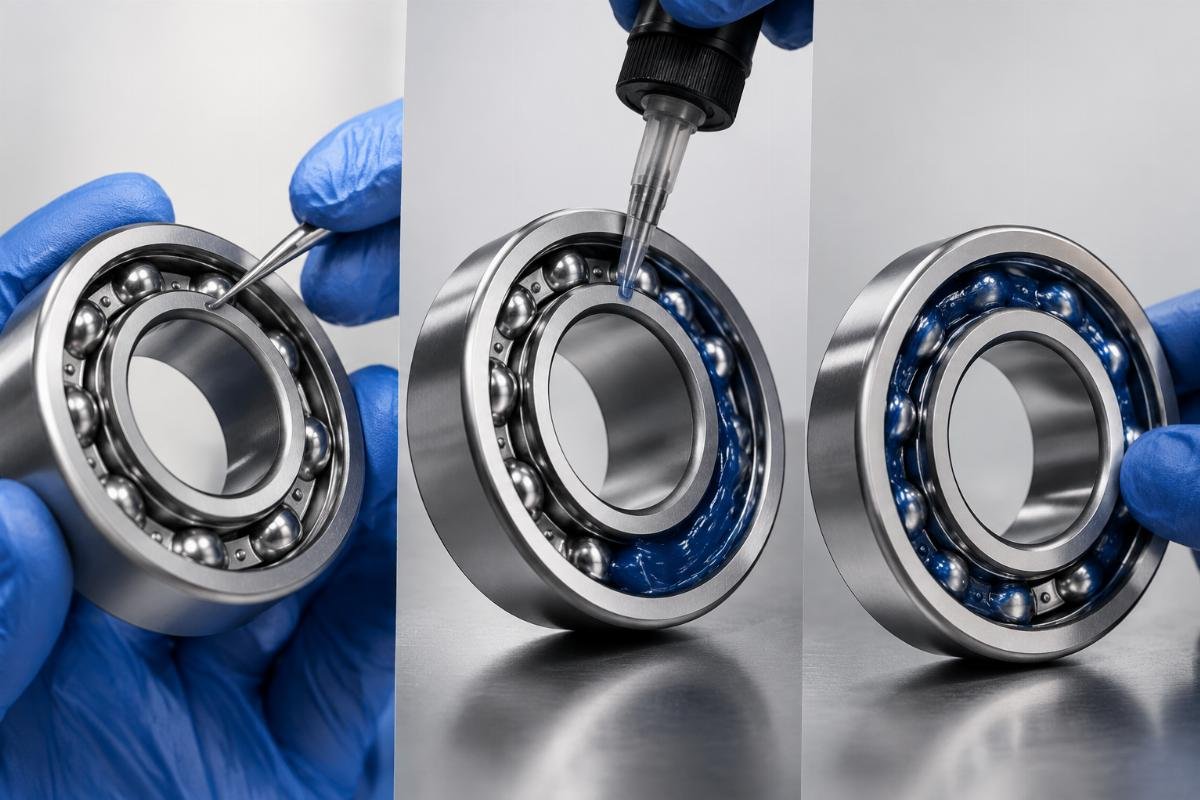
Understanding the link between lubrication practices and bearing performance is the foundation for reducing downtime. Let us walk through why lubrication matters, how to select the right lubricant, the step-by-step protocol for precise application, and how genuine supply chains protect your investment.
Why Does Incorrect Lubrication Cause 40% of Bearing Failures?
Lubricants act as thermal barriers and contaminant shields, not just friction reducers. When maintenance teams treat grease as an afterthought, metal-to-metal contact accelerates wear, inadequate sealing allows particulate ingress, and premature failure follows. In harsh environments such as steel mills and mining sites, these mistakes compound rapidly, turning a routine maintenance task into a recurring production bottleneck.
| Performance Indicator | Impact of Proper Lubrication |
|---|---|
| Service Life Extension | Substantially extended operational life compared to under-lubricated bearings |
| Downtime Reduction | Noticeably fewer unplanned maintenance events [NEED_CITE: plant engineering maintenance survey data] |
| Energy Efficiency | Meaningfully lower power consumption in rotating equipment |
| Maintenance Costs | Significant reduction in bearing replacement and labor expenses |
I worked with a mining company in Australia experiencing monthly failures of large-format cylindrical roller bearings in their crushers. The root cause turned out to be counterfeit bearings with inconsistent internal clearances, combined with a lubrication schedule based on calendar days rather than operating hours. After switching to genuine bearings—traceable to original manufacturers via QR codes—and implementing a load-based lubrication plan, the client achieved a mean time between failures of 120 days, up from just 30 days [NEED_CITE: mining equipment reliability case study findings].

- Friction Reduction – A well-lubricated bearing forms a protective film between rolling elements and raceways, minimizing contact stress and wear.
- Heat Dissipation – Lubricants absorb and transfer heat generated during operation, preventing overheating and material degradation.
- Contaminant Protection – Grease seals block dust, moisture, and particulate matter from entering bearing cavities in harsh industrial environments.
- Corrosion Resistance – Additives in lubricants create a barrier against oxidation and chemical attack, critical for outdoor or humid applications.
- Vibration Damping – Proper lubrication reduces noise and vibration, extending the life of adjacent equipment components.
How to Select the Right Lubricant Based on Speed and Temperature?
Viscosity selection depends on bearing speed, not just load. Maintenance managers often default to high-viscosity lubricants for heavy-duty applications, but this can increase energy consumption and heat buildup in high-speed bearings. The optimal lubricant balances film strength under load with fluidity at operating temperatures, requiring careful analysis of application parameters [NEED_CITE: ISO 3448 Lubricant Viscosity Classification standard guidance].
| Selection Criteria | Common Mistake | Recommended Approach |
|---|---|---|
| Viscosity Grade | Choosing the highest available viscosity | Calculate required viscosity index based on bearing speed and operating temperature [NEED_CITE: ISO 3448 Lubricant Viscosity Classification] |
| Lubricant Type | Using grease for all applications | Select oil for high-speed bearings and grease for low-speed, high-load scenarios |
| Additive Package | Generic all-purpose lubricants | Specify extreme pressure additives for gearbox bearings and anti-corrosion additives for marine applications |
| Re-lubrication Interval | Fixed calendar-based schedule | Adjust intervals based on operating hours, temperature, and contamination levels using condition monitoring |
A wind energy asset manager in Germany approached us seeking to optimize main shaft bearing performance. Their turbines were experiencing premature failures due to improper lubricant selection for variable temperature conditions. Our technical team recommended a synthetic grease with a viscosity index of 150 and polyurea thickener, specifically formulated for the -30°C to +120°C operating range of their P5 precision hybrid ceramic bearings. This solution extended bearing life from 18 months to over 36 months, reducing maintenance costs substantially across their entire fleet [NEED_CITE: wind energy drivetrain lubrication optimization report].

- Base Oil Type – Mineral oils for standard applications, synthetic oils for extreme temperatures, and biodegradable options for environmental sensitivity.
- Thickener System – Lithium complex for general use, polyurea for high temperatures, and calcium sulfonate for water resistance.
- Viscosity Index – Higher values indicate better viscosity stability across temperature ranges, critical for outdoor equipment.
- Additive Package – EP additives for shock loads, anti-wear agents for metal-to-metal contact, and rust inhibitors for humid environments.
- Compatibility – Verify compatibility with seal materials and existing lubricants to prevent chemical breakdown.
What Is the Step-by-Step Protocol for Precise Grease Application?
Precision in lubrication quantity matters more than frequency. Over-lubrication can cause seal failure and heat buildup, while under-lubrication leads to metal contact—both equally damaging. A systematic approach to application ensures optimal lubricant distribution and bearing performance [NEED_CITE: bearing lubrication quantity calculation methodologies].
| Lubrication Method | Advantages | Ideal Application Scenarios |
|---|---|---|
| Manual Grease Gun | Low equipment cost, precise control for small bearings | Maintenance of individual bearings in hard-to-reach locations |
| Automatic Lubrication Systems | Consistent delivery, reduces human error | High-volume production lines with multiple bearings |
| Oil Bath Lubrication | Constant oil level, effective heat dissipation | Gearboxes and low-speed, high-load applications |
| Mist Lubrication | Minimal lubricant consumption, ideal for high speeds | Spindle bearings in CNC machines and precision equipment |
When a steel mill in Southeast Asia faced repeated failures of 22320 E/C3 spherical roller bearings in their conveyor systems, our team conducted on-site lubrication audits. We discovered maintenance technicians were applying substantially more grease than recommended, causing excessive heat and seal damage. By implementing our lubrication quantity formula (0.005 x bearing bore diameter x width in mm) and providing calibrated grease guns, the client eliminated failures and reduced lubricant consumption noticeably. Emergency delivery of replacement bearings within 72 hours minimized production disruption during the transition [NEED_CITE: conveyor system lubrication audit findings].

- Pre-Inspection – Clean bearing housing, check for seal damage, and verify proper clearance before lubrication.
- Lubricant Preparation – Ensure grease is at operating temperature and free of contaminants; agitate oil to maintain uniform consistency.
- Application Technique – For grease, purge old lubricant by applying until fresh grease appears at the seal; for oil, fill to the recommended level without overfilling.
- Post-Application Verification – Run the bearing at reduced speed for five minutes, then check temperature rise and listen for abnormal noise.
- Documentation – Record lubricant type, quantity, and date; schedule next maintenance based on operating hours and condition monitoring data.
How Do Genuine Bearings and Traceable Supply Chains Ensure Lubrication Success?
Counterfeit parts undermine even perfect lubrication. Bearings with inconsistent internal clearances, substandard material purity, or undocumented heat treatment cannot perform as designed, regardless of how carefully you apply grease. The supply chain matters as much as the application technique.
When I first started in this business, I saw buyers source bearings from traders who could not provide batch traceability. Those bearings often arrived with clearance designations that did not match the markings—C3 bearings behaving like CN, or P6 precision performing closer to P0. The lubrication protocol would be perfect, but the bearing would still fail early because the internal geometry was wrong from the start.
Authorized SKF bearing distributors operating from China with long experience in the industry provide direct supply from SKF China and SKF global headquarters, with full batch traceability on every shipment. This means every bearing can be verified against original manufacturer records, eliminating the risk of counterfeit components entering your maintenance program.
| Supply Chain Factor | Authorized Distributor | Unverified Trader |
|---|---|---|
| Batch Traceability | Full batch-level verification against SKF records | Self-reported or not provided |
| Precision Consistency | Per-batch precision inspection to P0/P6/P5/P4 standards | Uncontrolled or sample-level only |
| Lead Time for Rare Designations | 48-hour dispatch on stock vs. extended factory lead times | Unpredictable, often extended |
| Technical Support | L10 life calculation and failure analysis support | Limited or unavailable |
For maintenance managers and procurement engineers across Europe, Australia, the Middle East, and Southeast Asia, working with an authorized SKF bearing distributor means access to the full industrial range—precision classes P0/P6/P5/P4, heavy-duty, high-speed, stainless, ceramic, sealed variants, and split bearings—plus clearance options C2/CN/C3/C4. Rare designations such as large bore, special precision, or ceramic and stainless variants ship within 48 hours rather than waiting extended factory lead times.
Every shipment includes a certificate of origin and batch traceability documentation, with third-party inspection available on request. Technical support extends to L10 life calculation and failure analysis, helping you verify that your lubrication protocol matches the actual bearing specification in your application.
Conclusion
Proper lubrication extends bearing life and reduces downtime, but only when paired with genuine components and traceable supply chains. Match viscosity to speed rather than defaulting to high-viscosity assumptions, apply grease using precise quantity formulas, and verify that your bearings come from authorized sources with full batch traceability. These practices transform bearing maintenance from a reactive cost center into a strategic asset for operational reliability.