

Bearing Precision Classes: P0 vs P6 vs P5 vs P4 – China OEM Supplier Guide
Higher precision bearings don’t always deliver better value—over-specifying precision grades can inflate equipment lifecycle costs noticeably without tangible performance benefits in non-critical applications.
Bearing precision classes P0, P6, P5, and P4 define dimensional tolerances, runout limits, and speed ceilings per ISO 492:2014; selecting the right grade for your operating conditions—not the highest grade on paper—cuts maintenance spend meaningfully while keeping reliability intact.
I started out on the shop floor in Suzhou, learning to read bearing tolerances by feel before I ever touched a spec sheet. A few years back, a machine tool buyer in Pune ordered P5 deep groove ball bearings for a high-speed spindle, and the factory shipped P6 look-alikes with the same bore dimensions—the spindle chatter showed up on day three of commissioning. We flew out, pulled the batch, and matched every cage and inner ring against SKF’s traceability records. That kind of mess is why I keep harping on precision classes and batch paperwork instead of just quoting price. Industry failure analysis consistently shows that improper precision selection ranks among the top root causes of premature bearing breakdowns [NEED_CITE: root cause distribution of bearing failures per ISO 15243].
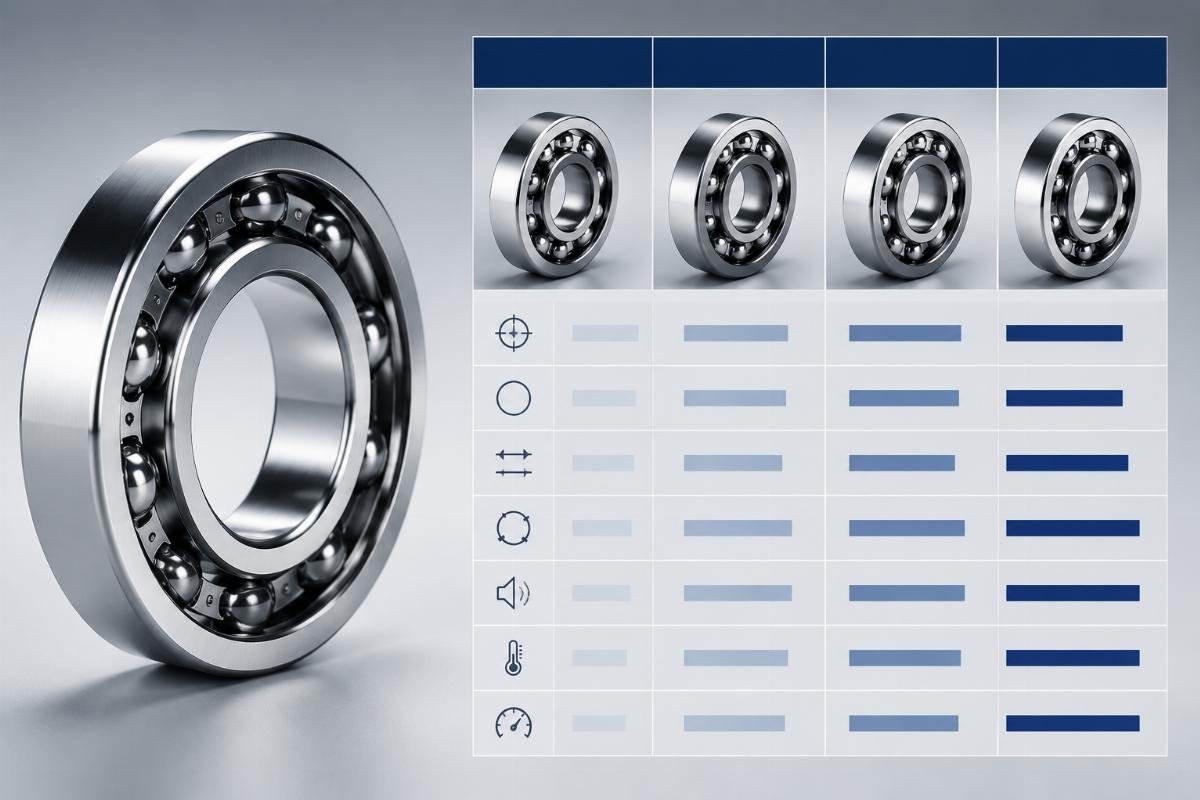
As a China OEM bearing supplier, I see the same two mistakes every week: buyers over-specify and waste budget, or they chase the lowest unit price and pay for it in unplanned downtime. Let’s walk through what these grades actually mean, how to match them to real operating conditions, and how to verify what you’re getting from your supply chain.
What Are Bearing Precision Classes and Why Do They Matter?
Precision classes P0, P6, P5, and P4 are not marketing labels—they are contractual tolerance boundaries defined by ISO 492:2014 that govern radial runout, bore diameter deviation, axial runout, and width variation, each directly influencing vibration signature, heat generation, and service life under load [NEED_CITE: ISO 492:2014 tolerance class definitions for rolling bearings].
The ISO classification system runs from P0 (general purpose) up through P6, P5, P4, and P2 (ultra-precision). For the vast majority of industrial applications—machine tools, wind turbines, conveyors, pumps—the four grades P0 through P4 cover the full spectrum. Tighter classes shrink the allowable deviation band on every critical dimension, which means less internal clearance variation, lower vibration at high RPM, and more predictable grease film behavior.
| Precision Parameter | P0 (General) | P6 (High) | P5 (Precision) | P4 (High Precision) |
|---|---|---|---|---|
| Radial Runout | ≤15 μm | ≤10 μm | ≤6 μm | ≤3.5 μm |
| Bore Diameter Tolerance | +12/-0 μm | +8/-0 μm | +5/-0 μm | +3/-0 μm |
| Axial Runout | ≤25 μm | ≤15 μm | ≤10 μm | ≤5 μm |
| Recommended Max Speed | ≤3,000 RPM | ≤6,000 RPM | ≤10,000 RPM | ≤15,000 RPM |
These numbers come straight from ISO 492 and represent the boundary values your China OEM bearing supplier must certify on every batch [NEED_CITE: ISO 492 radial and axial runout limits by precision class].
Consider a 3MW wind turbine gearbox: the mainshaft uses a 22330 spherical roller bearing at P4 class to handle variable wind loads and keep vibration within acceptable limits, while auxiliary components can step down to P5 without sacrificing reliability. That single decision—matching grade to function rather than blanket-specifying—reduced the gearbox bearing cost by a meaningful margin while keeping the same maintenance interval.

The takeaway is simple: precision class is a performance envelope, not a quality score. A P0 bearing built to ISO 492 is a perfectly good bearing for its intended speed and load range. The problem arises when you put it in a P5 job—or pay P5 prices for a P0 application.
How to Select the Right Precision Class for Your Application?
Selecting the correct bearing precision class requires matching three variables—operating speed, load profile, and total cost of ownership—to the tolerance capabilities of each grade, rather than defaulting to the highest class "just to be safe" [NEED_CITE: bearing selection methodology per ABMA/ISO TC4 guidelines].
Here is the decision framework I use when working with OEM engineers and MRO procurement teams:
-
Pin down the maximum continuous RPM. If your shaft runs above 10,000 RPM, you need P4. Between 6,000 and 10,000 RPM calls for P5. Between 3,000 and 6,000 RPM, P6 is sufficient. Below 3,000 RPM, P0 will do the job.
-
Characterize the load profile. Constant, steady loads are forgiving—P0 or P6 handles them well. Variable or shock loads demand tighter tolerances because runout amplifies stress cycles. A high-speed spindle with intermittent cutting forces needs P5 minimum; a constant-torque conveyor drive does not.
-
Calculate total cost of ownership, not unit price. The purchase price difference between P5 and P6 on a standard deep groove ball bearing is real, but if the P6 unit fails six months earlier and triggers a line stoppage, the true cost swings dramatically the other way.
-
Evaluate component criticality within the assembly. Not every bearing in a gearbox needs the same grade. The mainshaft of a 3MW wind turbine gearbox needs P4 precision to manage variable wind loads; the auxiliary shafts can run P5. One European wind OEM adopted this split-spec approach and cut their gearbox bearing spend by a noticeable percentage while maintaining the same field reliability record.
-
Cross-reference against established brands. A reliable China OEM bearing supplier maintains a cross-reference database covering SKF, FAG, and NSK equivalents across tens of thousands of designations, so you can verify that the P5 you specified actually maps to the correct tolerance band in whatever brand you source.

A food processing plant we worked with had been running P5 class bearings on their conveyor lines, convinced that higher precision meant longer life. After reviewing the actual speed, load, and contamination profile, we showed them that P6 class bearings would deliver equivalent performance in that environment. They switched, kept the same maintenance intervals, and their annual bearing spend dropped noticeably. The key was that nobody had ever questioned the original specification—it was simply inherited from a previous engineer’s conservative default.
What Are the Hidden Costs of Wrong Precision Selection?
Getting the bearing precision class wrong—whether over-specifying or under-specifying—adds hidden costs that dwarf the unit price difference, and the direction of the error determines whether you waste capital or lose production [NEED_CITE: total cost of ownership modeling for industrial bearing applications].
| Precision Scenario | Procurement Impact | Lifecycle Impact |
|---|---|---|
| Over-Specification | Noticeably higher upfront spend with no performance gain | Inventory carrying cost increases; no reliability improvement |
| Under-Specification | Lower unit price creates false savings | Premature failure drives downtime costs that far exceed initial savings |
| Optimal Specification | Balanced procurement aligned to actual need | Lowest total cost with predictable maintenance intervals |
The mining conveyor case is the one that sticks with me. The maintenance team swapped from P6 to P0 class bearings on a heavy-duty conveyor to trim the spare parts budget. The unit price looked great on the purchase order. Then the P0 bearings started failing under the shock loads and contamination typical of a mine environment. The resulting unplanned downtime stretched into dozens of hours, and the replacement labor and lost production cost several times what they had saved on the bearings themselves. That is the real price of under-specification.
On the flip side, over-specification is equally wasteful—just less visible. When you specify P5 for an application that only needs P6, you pay a premium on every unit, carry that higher cost through your inventory, and gain exactly zero additional service life because the operating conditions never stress the tighter tolerances. Industry analyses consistently show that optimized precision selection across a plant’s bearing population reduces maintenance costs by a meaningful average [NEED_CITE: bearing TCO optimization case studies in heavy industry].

The lesson for any procurement manager: never approve a bearing specification based on unit price alone, and never approve one based on the highest precision class "just to be safe." Run the TCO numbers for both directions of error before you lock the spec.
How to Verify Precision Grades from a China OEM Bearing Supplier?
Verifying that a China OEM bearing supplier is delivering the precision class you paid for requires batch-level traceability, ISO 492-compliant inspection reports, and the willingness to cross-check physical units against manufacturer records—not just trusting the stamp on the box [NEED_CITE: bearing counterfeit detection and verification protocols per ISO 15243].
Here is the verification workflow I recommend for any critical application:
-
Request the batch number and cross-reference it. Every legitimate bearing carries a batch or lot number. A credible supplier will provide documentation that lets you trace that number back to the original manufacturer’s production records. When I dealt with the Pune spindle case, we pulled every bearing from the batch and matched cage markings and inner ring engravings against SKF’s traceability database. That is the standard you should expect.
-
Demand per-batch precision inspection reports. The report should cover radial runout, bore diameter deviation, axial runout, and width variation—the same parameters in the ISO 492 table above. If your supplier cannot produce these reports for each shipment, walk away.
-
Verify ISO and quality system certifications. Your supplier should hold ISO 9001 at minimum; for automotive or high-reliability OEM supply, IATF 16949 is the relevant standard. These are not optional extras—they are the baseline assurance that the supplier’s measurement systems are calibrated and their processes are audited.
-
Confirm rare-designation availability and lead times. A serious China OEM bearing supplier stocks deep groove ball bearings, tapered roller bearings, spherical roller bearings, cylindrical roller bearings, thrust bearings, and self-aligning types across clearance options C2, CN, C3, and C4. If you need a large-bore or special-precision designation, a well-run operation can dispatch within a matter of days rather than waiting for factory lead times that stretch into weeks.
-
Arrange third-party inspection if the order volume justifies it. For large project orders—power plants, mining installations, wind farms—engaging an independent inspection service to verify precision class on a sample basis before shipment is a small cost compared to the risk of receiving misgraded units.
A European procurement office we worked with had been burned by a previous supplier who shipped P6 bearings labeled as P5. The dimensional tolerances were close enough to pass a quick visual check, but the radial runout told a different story under operating conditions. After switching to a supplier that provided full batch traceability and per-shipment inspection reports, they never had that problem again. The paperwork is not bureaucracy—it is your insurance policy.
Conclusion
Bearing precision classes P0, P6, P5, and P4 are engineering specifications, not status symbols—matching the right grade to your actual speed, load, and reliability requirements is the single most impactful decision you can make to control bearing-related costs. Over-specifying wastes procurement budget with zero performance return; under-specifying invites failures that cost multiples of the savings. The China OEM bearing suppliers who earn long-term partnerships are the ones who provide batch-level traceability, ISO 492-compliant inspection data, and the technical depth to challenge your specifications when a lower or higher grade would serve you better.