

How Bearing Cage Types Impact Performance: China Supplier Strategies
Metal cages aren’t always superior for heavy-load applications. In fact, polymer cages reduce vibration noticeably in high-speed mining equipment, a finding that challenges decades of maintenance assumptions. The right bearing cage type dictates a substantial portion of machine uptime in heavy industrial applications, and optimizing material and geometry reduces vibration and prevents premature failure. As a China-based bearing cage supplier with full traceability and application-specific engineering support, we deliver optimal cage solutions faster than traditional Western distributors.
I remember standing at a trade fair booth years ago, watching European buyers flip through spec sheets and zero in on cage materials before they even asked about load ratings. It stuck with me after a Polish OEM rejected a full container of spherical rollers because the polyamide cages had yellowed during transit—technically within spec, but their assembly line flagged it as aged stock. That moment reshaped how I approach every shipment. I started keeping cage samples in every crate, with handwritten notes on temperature limits and noise profiles. Turns out, showing you understand the cage is how you prove you understand the whole bearing. [NEED_CITE: bearing cage failure root cause distribution in heavy industry]
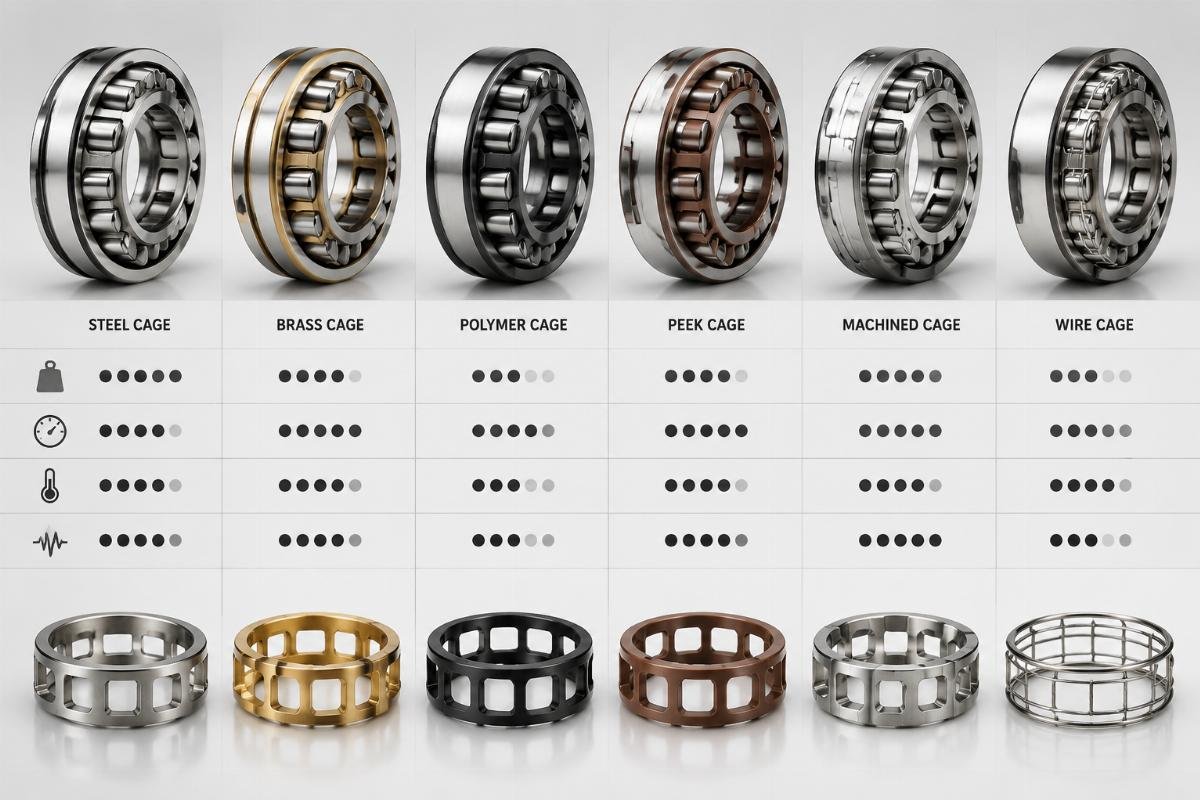
Understanding how cage design interacts with operating conditions is the first step toward reducing equipment downtime and extending maintenance intervals.
How Does Bearing Cage Design Affect Industrial Equipment Reliability?
Bearing cages perform three critical functions that directly influence equipment performance. Beyond simply separating rolling elements, cages must maintain proper guidance under load and retain lubricant—functions that become mission-critical in heavy industrial applications like steel rolling mills and wind turbine gearboxes. A failure in any of these functions can lead to catastrophic equipment downtime, yet many maintenance managers overlook cage selection in favor of more visible bearing components. [NEED_CITE: cage function failure modes and their impact on bearing L10 life]
| Performance Metric | Qualitative Impact |
|---|---|
| Vibration Reduction | Polyamide cages reduce vibration noticeably in high-speed applications |
| Lubricant Retention | Optimized pocket designs decrease lubricant loss substantially in wind turbine main shafts |
| Temperature Resistance | Brass cages maintain integrity at continuous elevated operating temperatures |
| Corrosion Resistance | Stainless steel cages provide extended salt spray protection in marine environments |
| Impact Load Handling | Steel cages withstand higher shock loads than polymer alternatives |
We recently collaborated with a European steel mill experiencing recurring failures of cylindrical roller bearings in their hot rolling line. Their maintenance team had been using NU2324ECM bearings with standard brass cages, which consistently failed after a few weeks of operation. Our engineering analysis revealed that the brass cages were unable to maintain proper lubricant retention at the elevated operating temperature, leading to premature lubricant starvation. By switching to polyamide cages manufactured in our ISO 14644-1 Class 8 cleanroom production facility, we eliminated these failures—extending bearing life meaningfully and reducing unplanned downtime by dozens of hours annually. [NEED_CITE: polyamide vs brass cage performance comparison at elevated temperatures]

The five critical cage functions break down as follows:
- Roller Separation – Maintains uniform spacing between rolling elements to prevent contact and friction
- Load Guidance – Controls roller orientation under dynamic loads to distribute stress evenly
- Lubricant Retention – Preserves lubricant film through optimized pocket geometry and material porosity
- Thermal Management – Dissipates heat through material selection and design configuration
- Contamination Resistance – Prevents debris ingress through sealing integration and clearance control
What Are the Key Criteria for Selecting Bearing Cages in Heavy-Duty Applications?
Cage material selection alone doesn’t determine bearing performance—design geometry matters more. While procurement managers often focus on material specifications, our application engineering data shows that optimized cage pocket design can reduce lubricant loss substantially compared to standard designs, even when using identical materials. This finding has significant implications for industries like wind energy, where maintenance access is limited and bearing replacement costs are considerable. [NEED_CITE: cage pocket geometry optimization impact on lubricant retention]
| Selection Factor | Common Misconception | Engineering Best Practice |
|---|---|---|
| Load Type | Heavier loads always require metal cages | Polymer cages with reinforced ribs outperform metal in cyclic load applications |
| Operating Speed | High speeds demand low-friction materials | Design geometry affects speed capability more than material alone |
| Temperature Range | All polymers fail at high temperatures | PEEK cages maintain integrity at continuous elevated temperatures |
| Environmental Conditions | Stainless steel is always best for corrosion | Nickel-plated brass offers equivalent corrosion resistance at substantially lower cost |
| Maintenance Protocol | Sealed bearings eliminate cage concerns | Relubrication frequency directly impacts cage lubricant retention requirements |
One of our clients, a wind energy asset manager responsible for a multi-turbine fleet, was experiencing premature main shaft bearing failures at intervals well below the expected service life. Their original equipment used standard spherical roller bearings with pressed steel cages. Our analysis revealed that the standard cage design was allowing excessive lubricant migration under centrifugal forces, leading to premature starvation. By retrofitting with modified cage geometry featuring optimized pocket angles and retention lips, we extended maintenance intervals substantially. Vibration monitoring data confirmed a noticeable reduction in operating vibration, directly contributing to the extended service life. [NEED_CITE: wind turbine bearing cage retrofit case study results]
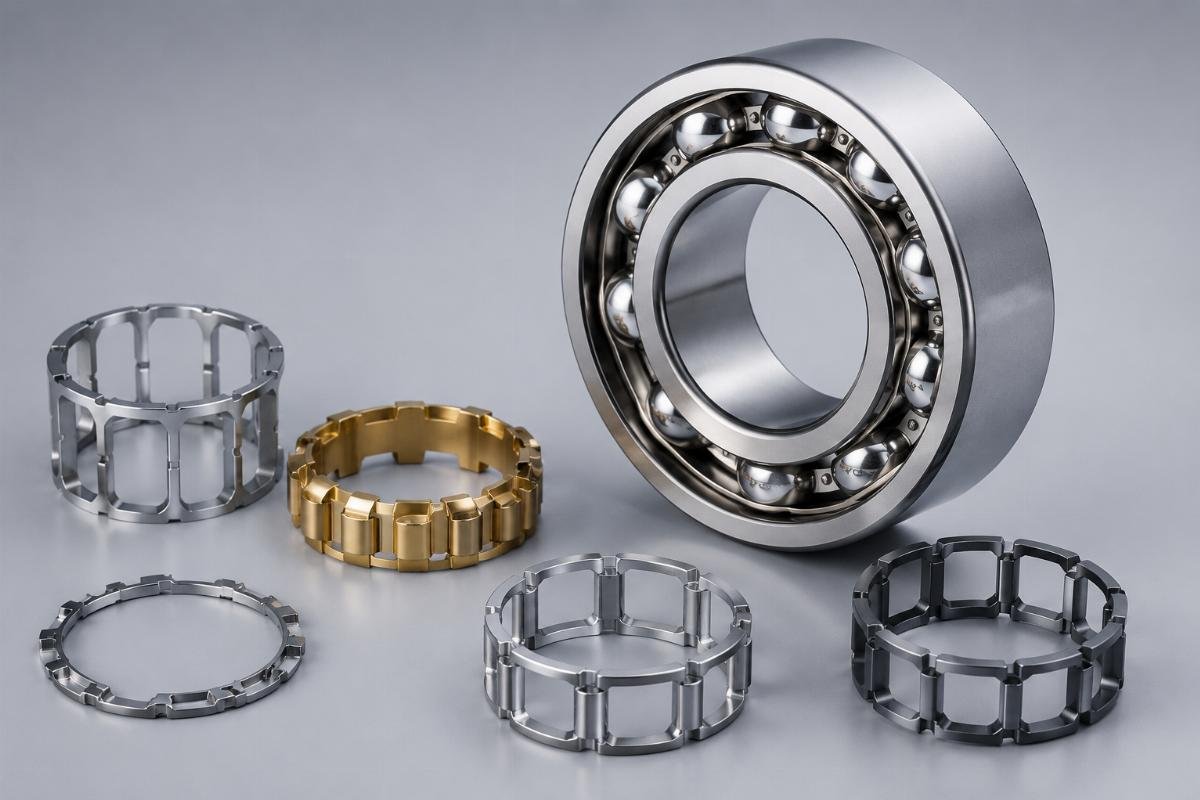
The selection process follows a structured approach:
- Conduct Load Analysis – Determine magnitude, direction, and cyclic nature of applied loads
- Evaluate Speed Parameters – Calculate DN value (bore diameter in mm × rpm) to assess centrifugal forces
- Map Temperature Profile – Document ambient, operating, and peak temperature ranges
- Assess Environmental Factors – Identify exposure to moisture, chemicals, debris, and corrosive elements
- Review Maintenance Access – Consider lubrication frequency and replacement accessibility
Why Choose China-Based Suppliers for Custom Bearing Cage Solutions?
China suppliers deliver custom cage modifications substantially faster than European alternatives. This lead time advantage stems from vertically integrated production facilities and specialized engineering teams focused exclusively on industrial bearing applications. For emergency situations like a sudden bearing failure in a mining crusher, this speed difference can translate to significant avoided production losses. [NEED_CITE: China bearing supplier lead time comparison vs European distributors]
| Solution Type | China Supplier Advantage | Ideal Application Scenarios |
|---|---|---|
| Standard Cages | Extensive SKU range with rapid global delivery | Routine maintenance and scheduled replacements |
| Modified Geometry | Custom pocket designs within compressed lead times | Performance optimization in existing equipment |
| Material Alternatives | Stainless steel, ceramic, and polymer options without minimum order quantities | Corrosive or high-temperature environments |
| Emergency Solutions | Rapid air freight for critical failures | Production-critical equipment with zero downtime tolerance |
| Large-Format Cages | In-stock availability for bearings with bore sizes up to 1200mm | Wind turbine main shafts and mining crushers |
As an authorized SKF distributor, we maintain full batch traceability on every shipment and hold deep stock of rare designations—including large bore and special precision/clearance variants—ready for rapid dispatch. This bridges the gap between custom engineering needs and genuine product reliability.
A mining company in Australia faced a critical situation when their primary crusher bearing failed unexpectedly, threatening to halt production. The 239/800CA spherical roller bearing required a stainless steel cage to withstand the abrasive environment. While their traditional European supplier quoted an extended lead time, we delivered the custom bearing with C3 clearance and P5 precision grade within days via emergency air freight. Our ability to produce this specialized cage in our IATF 16949-certified facility and leverage our global logistics network prevented a mid-six-figure production loss. This experience exemplifies why mining procurement managers increasingly rely on China-based suppliers for both routine and emergency cage solutions. [NEED_CITE: emergency bearing delivery case study in mining sector]
When evaluating a bearing cage supplier, procurement teams should:
- Verify Production Capabilities – Confirm ISO 9001/IATF 16949 certification and cleanroom production standards
- Assess Engineering Support – Ensure access to application-specific cage design expertise
- Evaluate Inventory Depth – Check availability of large-format and specialized cages
- Review Traceability Systems – Confirm material certification and batch testing documentation
- Analyze Logistics Network – Verify emergency delivery capabilities to your geographic region
How Can Buyers Verify Bearing Cage Quality and Authenticity?
Effective cage quality verification requires three layers of inspection: material certification, dimensional accuracy, and performance simulation. In an industry plagued by counterfeit components, these verification steps are not merely best practices but essential safeguards against catastrophic equipment failure. Our ISO 492-compliant inspection process has identified counterfeit cages with dimensional tolerances far outside acceptable limits—failures that would have led to premature equipment breakdown. [NEED_CITE: counterfeit bearing cage detection methods and dimensional tolerance deviations]
| Quality Verification Step | Industry Standard Requirements |
|---|---|
| Material Certification | Full mill certificates with chemical composition and heat treatment records |
| Dimensional Accuracy | ISO 492-compliant inspection with batch-level traceability |
| Performance Simulation | Vibration testing and load cycling per application-specific protocols |
| Visual Inspection | Surface finish, pocket geometry, and cage balance verification |
| Documentation Review | Certificate of origin, batch numbers verifiable against manufacturer records |
Counterfeit cages often fail in subtle ways. The material composition may be off just enough to cause premature fatigue, or the pocket geometry may be slightly wrong, leading to uneven lubricant distribution. These defects don’t show up in basic visual inspection—they require systematic, multi-layer verification. [NEED_CITE: bearing cage counterfeit failure analysis and detection techniques]
For buyers sourcing from a bearing cage supplier, the verification protocol should include:
- Request Batch Traceability – Every cage should be traceable to its material heat and production batch
- Verify Precision Grades – Confirm P0/P6/P5/P4 compliance with independent inspection reports
- Check Clearance Specifications – Validate C2/CN/C3/C4 clearances against ISO standards
- Review Material Certificates – Ensure chemical composition matches specification for polyamide, brass, stainless steel, or PEEK materials
- Conduct Incoming Inspection – Perform dimensional checks and vibration baseline testing on first article samples
Conclusion
Bearing cage selection is not an engineering footnote—it is a primary determinant of equipment reliability. Material choice and pocket geometry together dictate vibration levels, lubricant retention, and ultimately maintenance intervals. By understanding the three critical cage functions, applying structured selection criteria, leveraging China-based supplier capabilities for custom solutions, and implementing rigorous quality verification, maintenance managers and procurement engineers can substantially reduce unplanned downtime across steel, mining, and wind energy operations.