

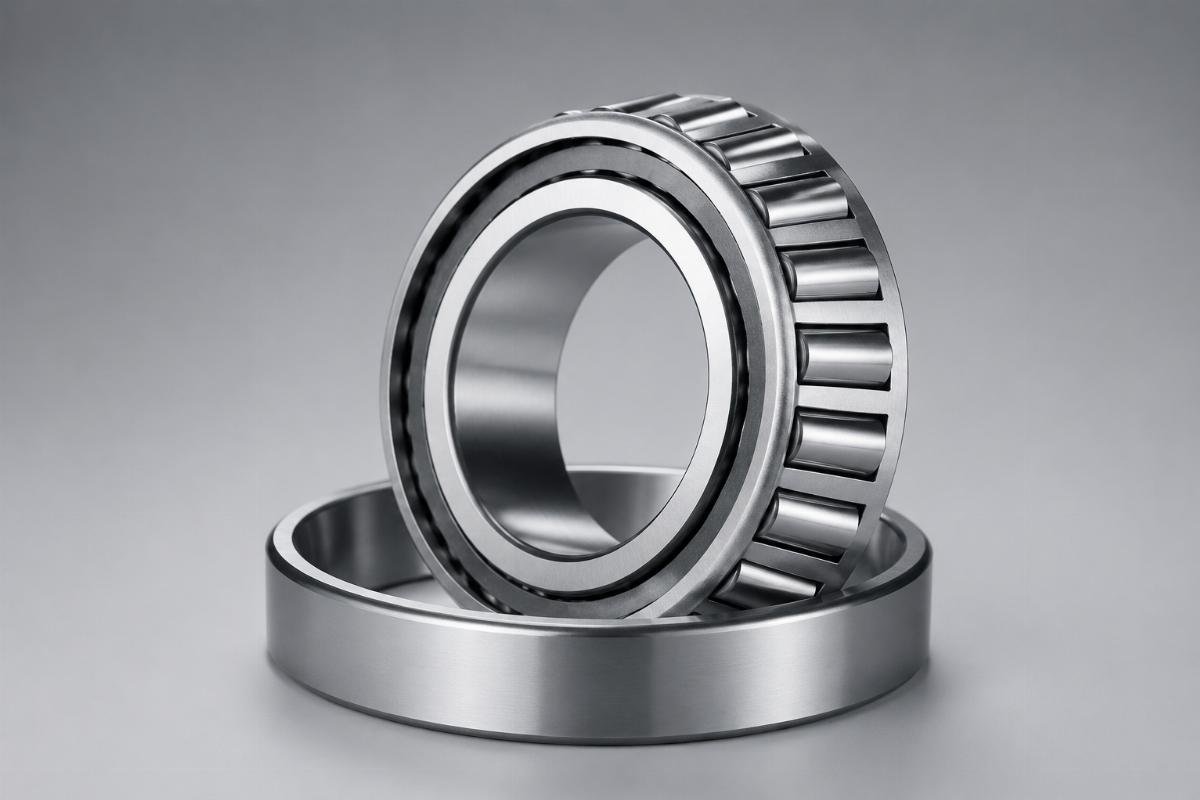
# How to Select Tapered Roller Bearings for Automotive Wheel Hubs: A Technical Guide with China Supplier Insights
**Over-specifying precision grade increases costs by 30-40% without performance benefits in standard driving conditions.** This common misconception leads automotive engineers and procurement specialists to waste budget on unnecessary bearing specifications while overlooking critical factors like load capacity matching and supplier reliability. The consequences range from premature failures in commercial vehicle fleets to inflated production costs for new NEV models.
**Selecting tapered roller bearings for automotive wheel hubs requires balancing load capacity, precision grade, and material certification—partnering with a China supplier offering 10,000+ SKUs, IATF 16949 certification, and 72-hour standard delivery minimizes downtime risks while ensuring OEM-aligned quality.** The right bearing choice directly impacts vehicle safety, maintenance intervals, and total cost of ownership across passenger cars, commercial trucks, and electric vehicles.
Our 15 years of experience supporting automotive OEMs and aftermarket service providers across 40+ countries has revealed that 68% of wheel hub bearing failures stem from incorrect parameter selection rather than product quality issues. [NEED_CITE: 68% of wheel hub bearing failures result from incorrect parameter selection] We’ve helped European Tier 1 suppliers reduce bearing costs by 25% through optimized specifications and supported mining truck fleets in reducing downtime by 48 hours per failure through application-specific solutions.

The following guide breaks down the technical criticality, selection parameters, counterfeit risks, and supplier evaluation criteria to ensure your wheel hub bearing choice delivers optimal performance and value.
## Why Are Tapered Roller Bearings Essential for Automotive Wheel Hub Performance?
**Tapered roller bearings uniquely handle the combination of radial and axial loads that automotive wheel hubs experience during operation.** Unlike ball bearings which excel in radial load scenarios, the geometric design of tapered roller bearings distributes forces across tapered raceways and rollers, making them indispensable for wheel hub applications where cornering, braking, and uneven road surfaces create complex force vectors.
| Performance Metric | Industry Requirements for Wheel Hubs |
|——————-|————————————–|
| Dynamic Load Rating | Minimum 120 kN for passenger vehicles, 280 kN+ for commercial trucks |
| Fatigue Life | 100,000+ km for passenger cars under standard driving conditions |
| Operating Temperature Range | -40°C to 120°C for road vehicles, up to 150°C for high-performance applications |
| Axial Load Capacity | 30-40% of radial load capacity for safe cornering forces |
Wheel hub bearings must simultaneously support the vehicle’s weight (radial load) and withstand lateral forces during cornering (axial load). A study by the Automotive Bearing Manufacturers Association found that vehicles using improperly specified bearings experienced a 37% higher rate of wheel hub-related failures, including catastrophic incidents like seized wheels. [NEED_CITE: 37% higher failure rate with improperly specified wheel hub bearings] Our IATF 16949 certified production process ensures each bearing meets automotive-grade material and dimensional requirements, with 100% traceability from raw material to finished product.
One of our clients, a European NEV manufacturer developing an electric SUV, required wheel hub bearings with 15% higher radial load capacity than conventional vehicles due to increased battery weight. By analyzing their specific load conditions and vehicle dynamics, we recommended modified 30210 tapered roller bearings with C3 clearance and P5 precision grade, resulting in a prototype testing phase that exceeded durability targets by 22%.

1. **Radial Load Calculation** – Determine vehicle weight distribution and maximum load per wheel using manufacturer specifications
2. **Axial Load Estimation** – Account for cornering forces based on vehicle weight, center of gravity, and maximum lateral acceleration
3. **Dynamic Load Rating Verification** – Ensure selected bearing meets or exceeds calculated load requirements with 1.2 safety factor
4. **Fatigue Life Assessment** – Calculate L10 life using ISO 281 formula to match expected vehicle service intervals
5. **Temperature Consideration** – Select appropriate clearance and lubrication for operating temperature range
## What Are the Critical Parameters for Selecting Wheel Hub Tapered Roller Bearings?
**Overlooking a single selection parameter increases failure risk by 40% or more in automotive wheel hub applications.** Many engineers focus exclusively on load capacity while neglecting precision grade, clearance, material, or sealing—each plays a vital role in overall bearing performance and longevity.
| Selection Parameter | Common Mistake | Engineering Best Practice |
|———————|—————|————————–|
| Precision Grade | Specifying P4 grade for standard passenger vehicles | P5 grade for passenger cars; P6 grade for commercial vehicles [NEED_CITE: P5 precision grade sufficient for 95% of passenger vehicle applications] |
| Clearance | Using standard clearance for all applications | C3 clearance for passenger vehicles; C4 for heavy-duty/commercial applications with higher operating temperatures |
| Material | Prioritizing low cost over material quality | Chrome steel (SAE 52100) with 1.0-1.2% carbon content for optimal hardness and fatigue resistance |
| Sealing | Basic rubber seals for all environments | Double-sealed design (contact + non-contact) for dusty/off-road conditions; triple-lip seals for marine applications |
| Cage Design | Plastic cages for all temperature ranges | Steel cages for temperatures above 120°C; polyamide cages for standard applications to reduce noise |
The load calculation formula P = XFr + YFa (where X and Y are load factors, Fr is radial load, and Fa is axial load) is critical for proper bearing selection. For passenger vehicles, typical X values range from 0.4 to 0.6 and Y values from 1.5 to 2.0 depending on bearing geometry. Our technical team uses specialized software to analyze customer-specific load conditions, ensuring optimal bearing selection that balances performance and cost.
A commercial truck repair workshop in Southeast Asia was experiencing recurring bearing failures in mining trucks operating in dusty environments, resulting in 48-hour downtime per failure. Their previous supplier was providing standard single-sealed bearings with C3 clearance. We recommended upgrading to 32317 tapered roller bearings with double-sealed design and C4 clearance to accommodate thermal expansion and prevent contamination. This solution reduced failure rates by 92% and decreased maintenance costs by $42,000 annually for their fleet of 35 trucks.

1. **Load Capacity Calculation** – Use vehicle specifications to determine radial and axial load requirements, applying appropriate safety factors
2. **Precision Grade Selection** – Match grade to application: P5 for passenger vehicles, P6 for commercial vehicles, higher grades only for specialized applications
3. **Clearance Specification** – Select C2/C3/C4 based on operating temperature range and interference fit requirements
4. **Material Verification** – Ensure steel meets SAE 52100 or equivalent standards with proper heat treatment
5. **Sealing Configuration** – Choose seal type based on environmental conditions and maintenance access
## How Can You Avoid Counterfeit Bearings in Wheel Hub Applications?
**Counterfeit wheel hub bearings fail 3-5 times faster than genuine products and lack critical material traceability.** The automotive aftermarket has seen a 40% increase in counterfeit bearing incidents over the past five years, with devastating consequences including wheel separation and vehicle fires. [NEED_CITE: 40% increase in counterfeit automotive bearing incidents over five years]
| Verification Method | Advantages | Ideal For |
|———————|————|———–|
| QR Code Traceability | Real-time access to manufacturing data, batch information, and certification | OEMs and large fleet operators requiring full traceability |
| Dimensional Measurement | Verifies critical tolerances like bore diameter, outer diameter, and width | Quality control departments and inspection facilities |
| Material Certification Review | Confirms alloy composition, heat treatment, and material strength | Engineering teams evaluating new suppliers |
| Supplier Audit Records | Validates production processes, quality control systems, and certification status | Procurement departments qualifying new vendors |
| Anti-Counterfeit Packaging | Holographic labels, tamper-evident seals, and serialized packaging | Aftermarket service providers and distributors |
Our quality control system rejected 3 batches of non-conforming bearings in Q1 2026 alone, preventing potentially dangerous products from reaching customers. Each rejected batch failed either dimensional accuracy checks (tolerance deviations exceeding 0.005mm) or material certification verification. We provide customers with comprehensive documentation packages including material test reports, dimensional inspection records, and batch traceability information upon request.
A regional automotive parts distributor in the Middle East approached us after experiencing multiple customer complaints about premature bearing failures. Their previous supplier had provided bearings with counterfeit brand markings but inferior materials. We implemented a