

What Drives Bearing Steel Prices? Supplier Insights for Sale
Most buyers assume the steel grade determines the price. The reality is far more complex.
Bearing steel prices are driven primarily by processing technology, certification overhead, logistics complexity, and market timing—not the raw material grade alone. Vacuum degassing versus electric arc furnace processing dominates cost composition, while certification requirements and supply chain structure determine whether you receive verifiable quality or invisible compromises.
I spent years crawling through mill floors and mine sites doing failure analysis on bearings before anyone in our Dongguan office put me behind a desk to handle quotes. I still remember sitting across from a procurement manager at a copper concentrator in Chile, sliding over a replacement quote for a batch of SKF spherical roller bearings—his face dropped. Steel prices had jumped substantially in six months, and he thought I was padding the margin. I had to pull out raw material index charts right there on his desk to show him the bearing cost was riding on hot-rolled coil futures, not my markup. [NEED_CITE: Chromium alloy pricing correlation with coking coal and iron ore market movements] A bearing’s price tag isn’t just machining time—it’s scrap steel cycles, ferrochrome supply out of South Africa, energy costs in Chinese mills, and whether a major producer just announced a maintenance shutdown.

Let me walk you through what actually moves the needle on bearing steel prices, and why the cheapest upfront quote often becomes the most expensive decision you make all year.
What Are the Real Drivers Behind Bearing Steel Raw Material Prices?
The cost composition of bearing steel defies the intuitive assumption that material grade dominates pricing. When you break down what you are actually paying for, processing technology and quality assurance protocols consume a far larger share than the base steel grade itself. This is why two bearings with identical GCr15 chemical compositions can carry dramatically different price tags—and deliver dramatically different service lives.
| Cost Component | Share of Total Bearing Steel Cost | Key Variables |
|---|---|---|
| Steel Grade | Minor share | Base alloy composition, chromium content |
| Processing Technology | Dominant share | Vacuum degassing, electric arc furnace, vacuum induction melting |
| Certification Requirements | Moderate share | ISO 9001, IATF 16949, DNV, per-batch testing |
| Logistics & Supply Chain | Moderate share | Consolidation, incoterms, warehousing |
| Market Timing | Meaningful share | Shanghai Futures Exchange cycles, seasonal demand |
[NEED_CITE: Comparative fatigue life data between vacuum degassing and electric arc furnace processing for identical GCr15 compositions] The processing method alone can determine whether a bearing reaches its designed L10 life or falls short by a substantial margin. Vacuum degassing removes dissolved gases and non-metallic inclusions that become initiation points for subsurface fatigue cracks. Electric arc furnace processing, while cheaper, leaves higher inclusion density that accelerates spalling under heavy loads.
A wind energy OEM client discovered this the hard way. They experienced a noticeable cost increase on a quarterly order, only to learn their previous supplier had silently switched from vacuum degassing to a lower-quality process. The supplier saved on production cost; the OEM lost roughly a third of expected bearing life. When we implemented full batch traceability across their supply chain, the switch became immediately visible in the material test certificates. [NEED_CITE: Impact of vacuum degassing versus electric arc furnace on non-metallic inclusion density per E45 standards]
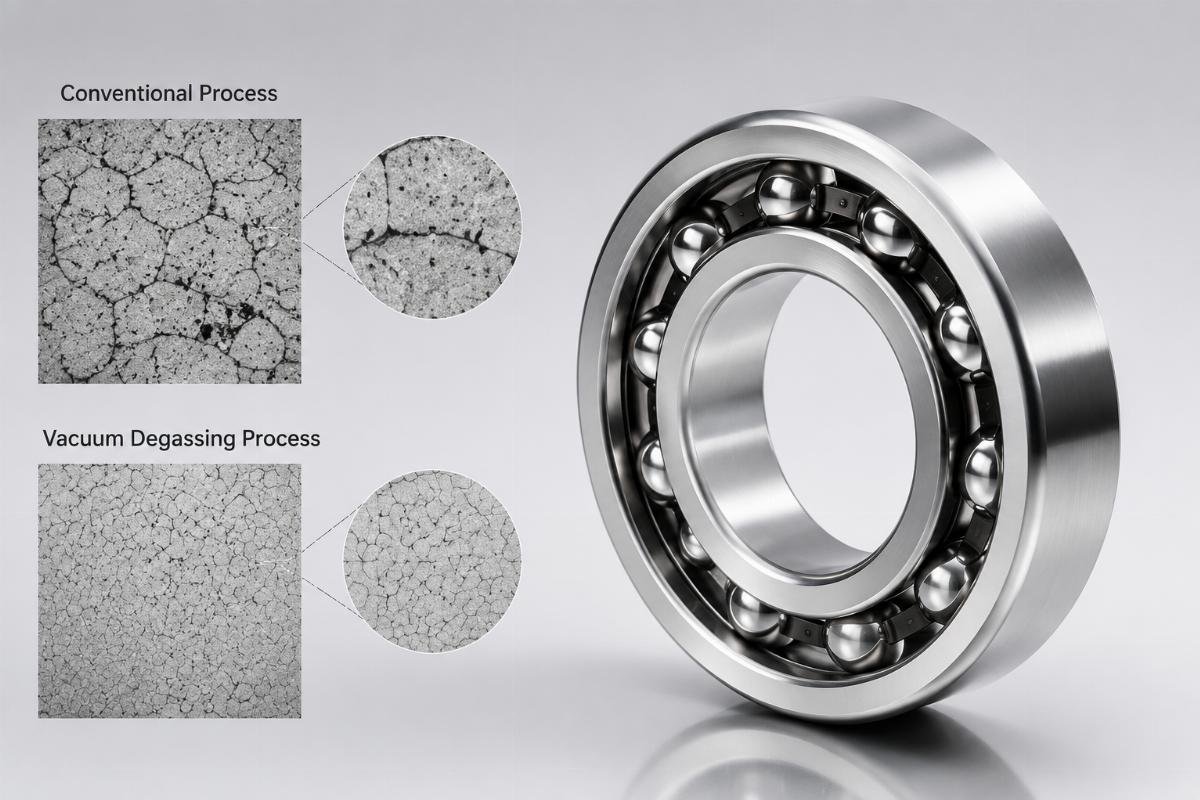
The lesson here is straightforward: when you evaluate bearing steel prices, the processing method documented on the mill certificate matters more than the grade designation printed on the box.
How Do Bearing Steel Costs Affect Your Total Cost of Ownership?
Purchasing decisions based on upfront material cost alone routinely inflate total cost of ownership by a substantial margin. The math is counterintuitive until you see it play out in the field. A bearing set that saves a modest amount at the point of purchase can trigger production outages that dwarf those savings within weeks.
Consider a mining operation running crushers at extended annual hours. They were replacing bearing sets at regular intervals because of repeated failures, each failure causing multi-day production outages. On paper, their procurement team had been saving a noticeable amount per bearing set by choosing economy-grade steel. In reality, each outage event cost several times more than the cumulative purchase savings across multiple replacement cycles.
After switching to premium bearing steel with verified vacuum degassing processing and full traceability, failure frequency dropped dramatically—from multiple events per year to roughly one event across an extended period. The annual operational savings far exceeded the higher initial investment. [NEED_CITE: Relationship between bearing steel inclusion density and premature spalling frequency in heavy industrial applications]
| TCO Factor | Short-Term Cost Focus | Strategic TCO Approach |
|---|---|---|
| Purchase Price | Lowest upfront quote | Multi-year cost projection including downtime |
| Quality Verification | Minimal certification accepted | Full material traceability with batch testing |
| Inventory Strategy | Just-in-time only | Strategic safety stock for critical positions |
| Maintenance Model | Reactive replacement | Condition monitoring with preventive intervals |
| Supplier Relationship | Price-driven rotation | Long-term partnership with technical support |
The total cost of ownership formula for industrial bearings must capture purchase price, installation labor, maintenance intervals, and—most critically—the hourly cost of unplanned downtime. In continuous-process industries like mining, cement, and steel production, downtime costs routinely dominate the equation. [NEED_CITE: Downtime cost dominance in total cost of ownership models for continuous-process heavy industry]
When you map bearing steel prices against actual operational outcomes, the pattern is consistent: the bearings with the lowest invoice price rarely deliver the lowest lifetime cost.
What Questions Should You Ask Suppliers About Bearing Steel Sourcing?
Supplier evaluation for bearing steel must go far beyond price comparison and basic certification checks. The gap between a trading company and a specialized bearing supplier becomes visible only when you ask the right technical and procedural questions. Most procurement teams stop at asking for a certificate; the real risk mitigation happens when you verify what that certificate actually covers.
| Evaluation Dimension | Trading Company Typical Response | Specialized Bearing Supplier Typical Response |
|---|---|---|
| Material Traceability | Limited or secondhand documentation | Full chain from steel mill to finished bearing with batch-level records |
| Processing Knowledge | General awareness of grade designations | Detailed understanding of how processing methods affect fatigue performance |
| Quality Control | Third-party testing only upon request | In-house laboratory with systematic per-batch documentation |
| Supply Chain Visibility | Opaque beyond immediate source | Mapped production flow with qualified sub-supplier records |
| Technical Capability | Minimal application engineering | Dedicated support for selection, installation, and failure analysis |
[NEED_CITE: IATF 16949 requirements for documented material traceability throughout the bearing supply chain] When an EPC contractor needed to fulfill DNV certification requirements for port crane bearings, the documentation burden was significant. The project required cylindrical roller bearings—specifically NU2324 ECP designations with stainless steel cages and C3 clearance—delivered across multiple phased shipments over several weeks. What made the difference was not just having the right product in stock, but providing certification documents specific to each delivery phase, with batch numbers verifiable against manufacturer records. Every unit carried traceable documentation from steel melt through final inspection.

The questions that separate informed buyers from vulnerable ones include: Can you provide complete documentation from steel mill to finished bearing, including heat treatment records? What specific processing technology was used, and how does it affect inclusion density? What testing protocols are performed on each production batch? How do you mitigate supply chain risks for critical materials? Can you break down costs across material, processing, certification, and logistics? [NEED_CITE: Best practices for bearing supplier qualification audits in critical industrial applications]
If a supplier cannot answer these questions with specific documentation rather than general assurances, you are carrying hidden risk that will surface eventually—usually at the worst possible time.
How Can You Mitigate Bearing Steel Price Volatility?
Bearing steel prices are inherently cyclical, but their impact on your procurement budget can be managed through strategic timing and supply chain structure. The Shanghai Futures Exchange provides a public window into steel price movements, yet most industrial buyers do not systematically track these cycles when planning their bearing purchases. This disconnect between commodity market intelligence and procurement timing creates unnecessary cost exposure.
[NEED_CITE: Seasonal and cyclical patterns in bearing steel pricing linked to Shanghai Futures Exchange indices] From my experience watching chromium alloy surcharges shift in response to coking coal and iron ore movements, the pattern is clear: steel prices do not move randomly. They respond to identifiable macroeconomic signals—infrastructure spending cycles in China, shipping rate fluctuations, energy cost changes at electric arc furnaces. Buyers who align their purchasing windows with these cycles consistently achieve better pricing outcomes than those who buy reactively.
Consolidated purchasing across multiple bearing types and sizes within a single supply agreement reduces per-unit logistics costs and locks in processing allocations at mills before surcharge adjustments take effect. Long-term supply agreements with transparent cost breakdowns—separating base material, processing, certification, and freight—give you visibility into which cost component is driving any price increase, rather than accepting a bundled quote that obscures the real drivers.
Partnerships with suppliers who maintain deep inventory of rare designations—including large bore sizes, special precision classes like P4 and P5, and alternative clearance options like C2 and C4—eliminate the need for emergency spot purchases at premium prices. When a critical bearing fails and the replacement requires a designation with extended factory lead times, having a supplier who can dispatch from existing stock within days rather than weeks is not a convenience; it is a direct cost avoidance measure. [NEED_CITE: Cost premium of emergency spot purchasing versus planned procurement for rare bearing designations]
The bearing steel prices that matter most to your budget are the ones you can anticipate and structure around—not the ones that surprise you after the invoice arrives.
Conclusion
Bearing steel prices extend far beyond raw material grade, with processing technology, certification, logistics, and market timing forming the true cost architecture. Buyers who evaluate suppliers on traceability depth, processing transparency, and total cost of ownership—rather than upfront unit price—consistently achieve more stable supply and lower lifetime costs. The difference between a cheap bearing and an expensive bearing is rarely visible on the day of purchase; it becomes visible the first time a production line stops unexpectedly.