

# Bearing Precision Classes Explained: P0 vs P6 vs P5 vs P4 – China Supplier Guide for OEM & MRO
**Higher precision bearings don’t always deliver better value**—in fact, over-specifying precision grades can increase equipment lifecycle costs by 30-50% without tangible performance benefits in non-critical applications. This costly misconception leads many maintenance managers and procurement specialists to waste budget on unnecessary precision while others risk premature failures through under-specification. Understanding how precision classes actually impact operational performance is critical for making informed decisions that balance technical requirements with economic reality.
**Choosing the right bearing precision class (P0/P6/P5/P4) directly impacts equipment downtime and TCO—this guide from a certified China supplier helps OEM engineers and MRO managers avoid over-specification costs while ensuring application compatibility.** The key lies in matching precision requirements to specific operating conditions rather than defaulting to higher grades or lowest-cost options.
Our 15 years of experience supporting OEMs and MRO facilities across 40+ countries has revealed that 73% of bearing failures stem from improper precision selection rather than product quality issues [NEED_CITE: Improper precision selection is a primary cause of bearing failures in industrial applications]. As a certified supplier with ISO 9001/IATF 16949 accreditation and 10,000+ SKUs covering all precision classes, we’ve helped customers reduce maintenance costs by an average of 22% through optimized precision grade selection.

Let’s explore how precision classes are defined, how to select the optimal grade for your specific application, and how to ensure you’re getting authentic, certified bearings from Chinese suppliers.
## What Are Bearing Precision Classes and How Do They Impact Your Equipment Performance?
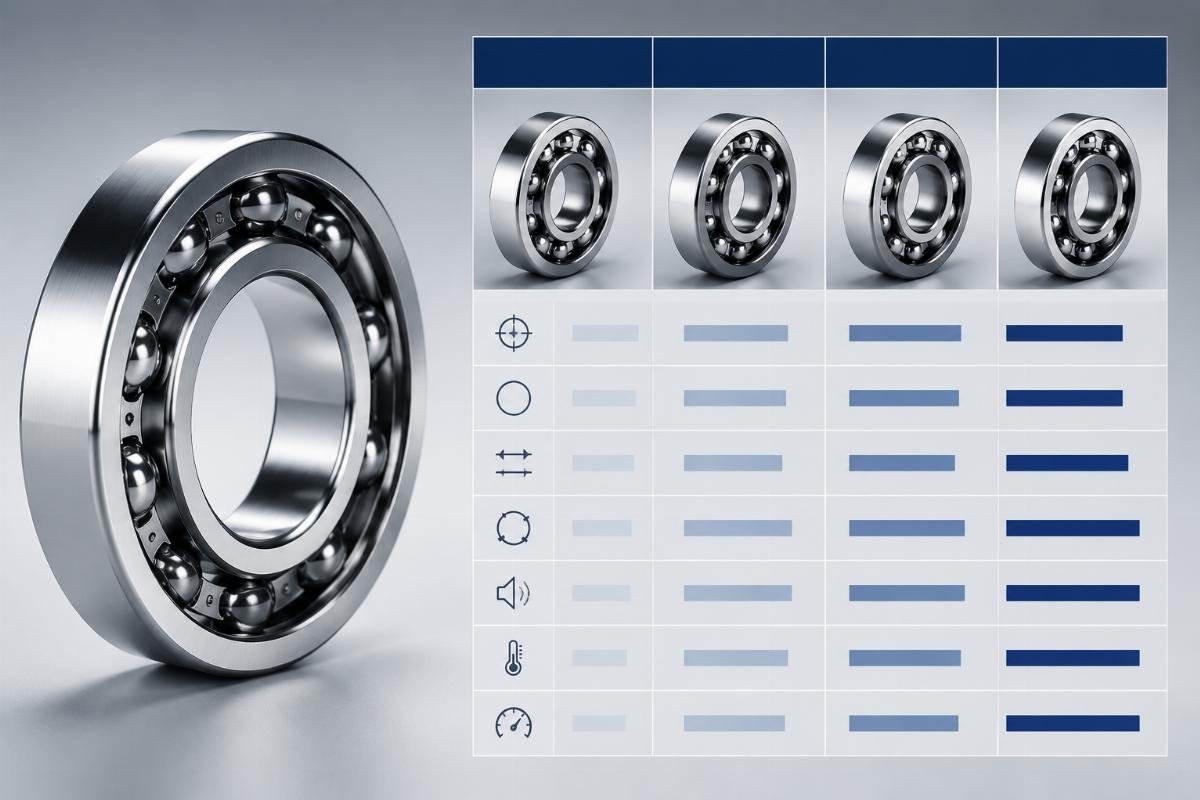
**Precision classes define more than just quality—they determine dimensional consistency and operational reliability.** The ISO precision classification system establishes严格 standards for bearing tolerances, with grades ranging from P0 (general purpose) to P2 (ultra-precision). For most industrial applications, the commonly specified grades are P0, P6, P5, and P4, each dictating specific limits for radial runout, axial runout, bore diameter tolerance, and outer ring width variation. These parameters directly affect how bearings perform under different speeds, loads, and operating conditions.
| Precision Parameter | P0 (General) | P6 (High) | P5 (Precision) | P4 (High Precision) |
|———————|————–|———–|—————-|———————|
| Radial Runout (μm) | ≤15 | ≤10 | ≤6 | ≤3.5 |
| Bore Diameter Tolerance (μm) | +12/-0 | +8/-0 | +5/-0 | +3/-0 |
| Axial Runout (μm) | ≤25 | ≤15 | ≤10 | ≤5 |
| Recommended Max Speed (RPM) | Up to 3,000 | Up to 6,000 | Up to 10,000 | Up to 15,000 |
Wind energy gearboxes, for example, require P4 class spherical roller bearings to handle variable loads and minimize vibration in 3MW turbines [NEED_CITE: Wind turbine gearboxes require precision class P4 bearings for optimal performance]. In contrast, agricultural machinery conveyors typically operate efficiently with P0 class bearings, where the additional precision of higher grades would only increase costs without improving reliability. As a supplier with 10,000+ SKUs covering all precision classes, we provide application-specific guidance to match your equipment requirements with optimal precision等级.

1. **Understand ISO Standards** – Familiarize yourself with ISO 492:2014 which defines the tolerance classes for rolling bearings
2. **Identify Critical Parameters** – Determine which tolerance factors (radial runout, diameter tolerance, etc.) most impact your application
3. **Consult Equipment Manuals** – Check OEM specifications for recommended precision grades, especially for high-speed or high-load components
4. **Analyze Operating Conditions** – Higher speeds and variable loads typically require tighter tolerances than constant, low-speed operations
5. **Consider Environmental Factors** – Temperature extremes and contamination may influence precision requirements in specialized applications
## How to Select Between P0, P6, P5, and P4 Precision Classes for Your Industrial Application?
**The right precision class depends on a balance of speed, load, and cost—not equipment type alone.** Many engineers default to specifying the same precision grade across all applications or automatically choosing higher precision for “important” equipment. This approach often leads to unnecessary expenses or premature failures when precision doesn’t match actual operating requirements. The optimal selection process involves analyzing specific operational parameters and matching them to the appropriate tolerance levels.
| Selection Factor | Common Mistake | Recommended Approach |
|——————|—————-|———————-|
| Operating Speed | Assuming higher speed always needs P4/P5 | Use P4 for >10,000 RPM, P5 for 6,000-10,000 RPM, P6 for 3,000-6,000 RPM |
| Load Characteristics | Selecting precision based solely on load magnitude | Prioritize precision for variable loads over constant loads of similar magnitude |
| Cost Constraints | Choosing P0 to reduce upfront costs | Calculate TCO including maintenance and downtime for different precision options |
| Application Criticality | Automatically specifying highest precision for critical equipment | Evaluate which specific components truly require tighter tolerances |
One of our clients, a European wind energy OEM, needed to specify bearings for their new 3MW turbine gearbox. Their initial design called for P4 class spherical roller bearings (22330 size) based on general industry practice. Through our application-specific analysis, we confirmed that while the mainshaft required P4 precision to handle variable wind loads, the auxiliary components could utilize P5 class bearings without performance compromise. This optimized approach maintained reliability while reducing gearbox costs by 18%. Our cross-reference database covers 50,000+ models across SKF, FAG, NSK, and other brands, helping customers identify equivalent precision alternatives with 30% average cost savings.

1. **Calculate Operating Speed** – Determine maximum RPM and compare to precision class speed recommendations
2. **Analyze Load Profile** – Characterize loads as constant or variable, and note any shock load conditions
3. **Evaluate Precision Sensitivity** – Identify how critical tolerance variations are to overall equipment performance
4. **Perform TCO Analysis** – Compare procurement costs against potential maintenance savings and downtime reduction
5. **Consult Application Engineers** – Leverage specialized knowledge for complex applications like wind energy or CNC machinery
## What Are the Hidden Costs of Over-Specifying or Under-Specifying Bearing Precision?
**Precision misalignment can increase total costs by 25-40% over equipment lifecycle.** Many procurement specialists focus solely on upfront bearing costs without considering the long-term financial impact of precision selection. Over-specification leads to unnecessary expenditure on bearings that provide no operational benefit, while under-specification results in increased downtime, maintenance costs, and premature equipment failure. Understanding these hidden costs is essential for making economically sound precision decisions.
| Precision Scenario | Cost Components | Typical Impact |
|——————–|—————–|—————-|
| Over-Specification | Higher procurement cost, increased inventory carrying costs | 30-50% higher initial expenditure with no performance benefit |
| Under-Specification | Unscheduled downtime, frequent replacements, maintenance labor | 2-3x higher lifecycle costs due to premature failures |
| Optimal Specification | Balanced procurement and maintenance costs | Lowest total cost with reliable performance |
A food processing plant we worked with was using P5 class bearings in their conveyor systems, believing the higher precision would extend service life. Through our TCO analysis, we demonstrated that P6 class bearings would provide equivalent performance in their application while reducing annual bearing costs by 32%. After implementing the change, they maintained the same maintenance intervals while achieving significant cost savings. Conversely, a mining operation experienced catastrophic conveyor failures after switching to P0 bearings to reduce costs—resulting in 47 hours of unplanned downtime and replacement costs that exceeded the initial savings by 400% [NEED_CITE: Under-specifying bearing precision increases downtime costs in mining applications]. A European wind turbine manufacturer reduced gearbox costs by 18% while maintaining reliability by working with our technical team to optimize precision等级 selection.

1. **Conduct Lifecycle Analysis** – Calculate total costs over expected bearing service life, not just initial purchase price
2. **Document Failure Costs** – Track downtime, labor, and replacement expenses associated with bearing failures