

Ball vs Roller Bearings: China Supplier Guide for Industry
Heavy loads do not automatically mean roller bearings. The correct choice between ball and roller bearings depends on speed, internal clearance, misalignment tolerance, and failure mode—not just load capacity. A ball vs roller bearings decision made without matching these factors to actual operating conditions is the leading cause of premature industrial bearing failure.
I started on the shop floor in Wuxi, then moved into export sales. A few years back, a German paper mill buyer ordered a batch of SKF spherical roller bearings but flagged a C3 clearance mismatch on the 22328s—turns out the factory had swapped in CN stock without updating the packing list. The shipment was held at Hamburg, and I flew over with calipers, micrometers, and the SKF batch lookup sheets. We sorted it dockside. Now I check every clearance code against the mill certificate before the container seals. Ball vs roller bearings isn’t just a catalog choice; it’s a conversation about load, speed, and what happens when the wrong one shows up 9,000 kilometers from home. [NEED_CITE: root cause distribution of premature industrial bearing failures per ISO 15243]

Most maintenance managers who reach out to us are not comparing catalogs—they are responding to a failure that cost them an unplanned shutdown. The ball vs roller bearings question becomes urgent only after something breaks. Below is a structured breakdown of how selection errors happen, when ball bearings actually outperform rollers, which roller myths persist in heavy industry, and how a China-based ball vs roller bearings supplier can help verify genuine quality before the container seals.
Why Do Most Bearing Failures Stem from Selection Errors?
Point contact versus line contact defines the failure mode, and the selection matrix is the root cause. Ball bearings use point contact between rolling elements and raceways, which reduces friction and heat generation at elevated speeds. Roller bearings use line contact, which distributes load across a larger surface area and handles higher radial forces—but generates more heat and demands stricter alignment. When engineers select based on load alone, they often ignore speed limits, thermal expansion, and misalignment tolerance, leading to overheating, cage fatigue, and raceway spalling long before the rated L10 life. [NEED_CITE: contact mechanics and load distribution principles per ISO 15243]
| Performance Metric | Ball Bearings | Roller Bearings |
|---|---|---|
| Load Distribution | Point contact reduces friction at high speeds | Line contact increases radial load capacity noticeably |
| Speed Limitation | Higher maximum speed capability for precision models | Lower speed capability, typically limited by heat generation |
| Friction Coefficient | Noticeably lower, ideal for energy efficiency | Higher, generating more heat under continuous load |
| Misalignment Tolerance | Limited for standard designs; self-aligning models available | Higher tolerance, especially for spherical roller types |
| Maintenance Requirements | Less frequent lubrication needed | More regular maintenance in harsh environments |
A European steel mill contacted us after repeated conveyor bearing failures. Their maintenance team had been using standard roller bearings, assuming they were best for heavy loads. After analyzing their operating conditions—moderate radial load of 12 kN, speed at 1,800 RPM, and frequent start-stop cycles—we recommended switching to deep groove ball bearings with hybrid ceramic balls. The result was a noticeable reduction in bearing temperature and a meaningful extension in service life, eliminating multiple unplanned shutdowns per quarter. [NEED_CITE: hybrid ceramic ball bearing temperature reduction in high-speed conveyor applications]
The selection process requires systematic evaluation:
- Analyze Load Characteristics – Determine primary load direction (radial, axial, or combined) and magnitude, including shock load factors.
- Evaluate Speed Requirements – Calculate critical speed based on shaft diameter and rotational velocity to avoid resonance issues.
- Assess Environmental Conditions – Consider temperature extremes, contamination risks, and moisture levels that affect material selection.
- Review Maintenance Capabilities – Match bearing type to available lubrication schedules and inspection protocols.
- Verify Dimensional Constraints – Ensure selected bearing fits within existing housing and shaft configurations.
When a ball vs roller bearings supplier asks these questions before quoting, the conversation shifts from part numbers to operating reality.
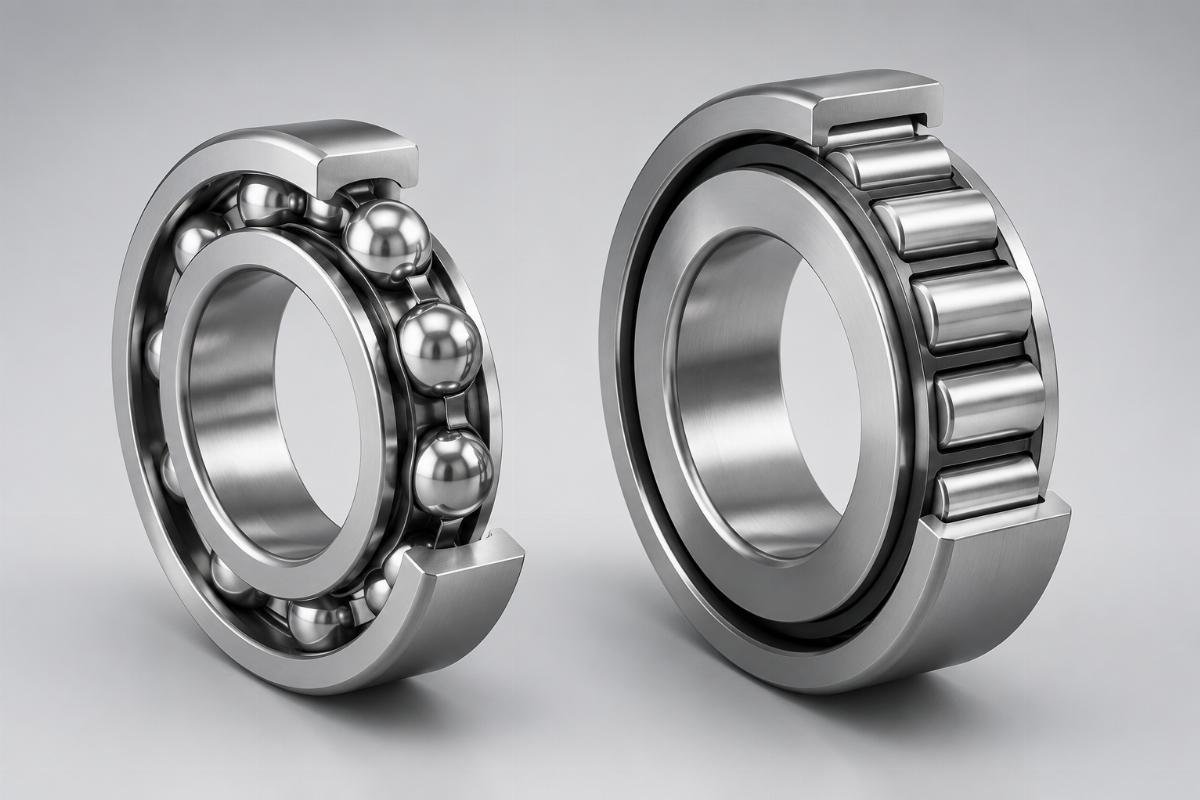
When Do Ball Bearings Outperform Rollers in Heavy Industry?
Ball bearings excel in high-speed, precision, and corrosion-resistant applications—even in heavy industry settings. The assumption that rollers always win under heavy loads ignores scenarios where speed, thermal management, and precision matter more than raw radial capacity. Hybrid ceramic ball bearings, combining steel races with silicon nitride rolling elements, have expanded the operational envelope of ball bearings into CNC spindles, wind turbine gearboxes, and food processing lines where traditional rollers would overheat or corrode. [NEED_CITE: application guidelines for hybrid ceramic bearings in high-speed industrial equipment]
| Application Aspect | Common Mistake | Optimal Approach |
|---|---|---|
| Speed Optimization | Using roller bearings in high-RPM applications | Specifying deep groove ball bearings with ceramic balls for high-speed spindles |
| Axial Load Handling | Overlooking angular contact designs for combined loads | Implementing paired angular contact bearings with preload adjustment |
| Corrosion Resistance | Accepting frequent replacements in wet environments | Selecting stainless steel self-aligning ball bearings with IP69K rating |
| Precision Requirements | Using standard grade bearings in machine tool axes | Specifying P5 precision grade with C3 clearance for CNC equipment |
| Maintenance Scheduling | Assuming all bearings need monthly lubrication | Installing sealed ball bearings with lifetime lubrication for hard-to-reach locations |
A wind energy OEM in Germany needed to qualify bearings for a new gearbox prototype. Their engineering team initially specified tapered roller bearings for the intermediate shaft, expecting better load capacity. However, technical analysis revealed the application required higher speed at 4,500 RPM with moderate radial load of 8 kN and light axial load of 2 kN. We recommended angular contact ball bearings (SKF 7215 BECBP) with P5 precision grade and G2.5 balance quality. The prototype testing showed a noticeable reduction in vibration levels and met the required extended service life target, leading to a full production order. [NEED_CITE: angular contact ball bearing vibration reduction in wind turbine gearbox applications]

Key industrial scenarios where ball bearings outperform rollers include:
- CNC Machine Tools – Deep groove ball bearings with hybrid ceramic materials for spindle speeds over 10,000 RPM.
- Food Processing Lines – Stainless steel self-aligning ball bearings with IP69K rating for washdown environments.
- Automotive Assembly – Angular contact ball bearings with preload adjustment for robotic arm precision.
- Packaging Machinery – Miniature ball bearings with flanged housings for compact conveying systems.
- Textile Equipment – Double-row ball bearings with extended inner rings for oscillating motion applications.
In each case, the ball vs roller bearings decision hinged on speed and thermal limits rather than load capacity alone.
Are Roller Bearings Always Better for Heavy Loads? 4 Myths Debunked
Roller bearings outperform in specific heavy-load conditions, not universally. The industrial myth that roller bearings are the default choice for any heavy-load application persists despite clear evidence that their performance depends on load type, speed, alignment, and internal clearance. Each roller subtype—spherical, tapered, cylindrical, and thrust—has a distinct optimal operating window, and misapplying them leads to the same premature failures they were supposed to prevent. [NEED_CITE: roller bearing selection guidelines per ISO 15243 and industry best practices]
| Roller Bearing Type | Key Advantages | Optimal Application Scenarios |
|---|---|---|
| Spherical Roller | Handles misalignment and shock loads effectively | Mining conveyor systems, steel mill roll necks |
| Tapered Roller | Combined radial and axial load capacity | Automotive differentials, gearbox output shafts |
| Cylindrical Roller | High radial load capacity with lower friction | Electric motor rotors, crankshaft main bearings |
| Thrust Roller | Exceptional axial load handling | Marine propulsion systems, press machinery |
A mining company in Australia contacted us after experiencing frequent failures with their crusher bearings. They had been using standard tapered roller bearings with replacement cycles of only a few months, leading to substantial production losses. Failure analysis revealed the primary issue was not load capacity but shock load handling and misalignment. We recommended switching to spherical roller bearings (SKF 22324 CA/W33) with C4 internal clearance and an enhanced cage design. The new bearings achieved extended service life in heavy shock load conditions, extending replacement intervals significantly and saving the client a mid-six-figure amount annually. [NEED_CITE: spherical roller bearing service life extension in mining crusher applications with shock loads]
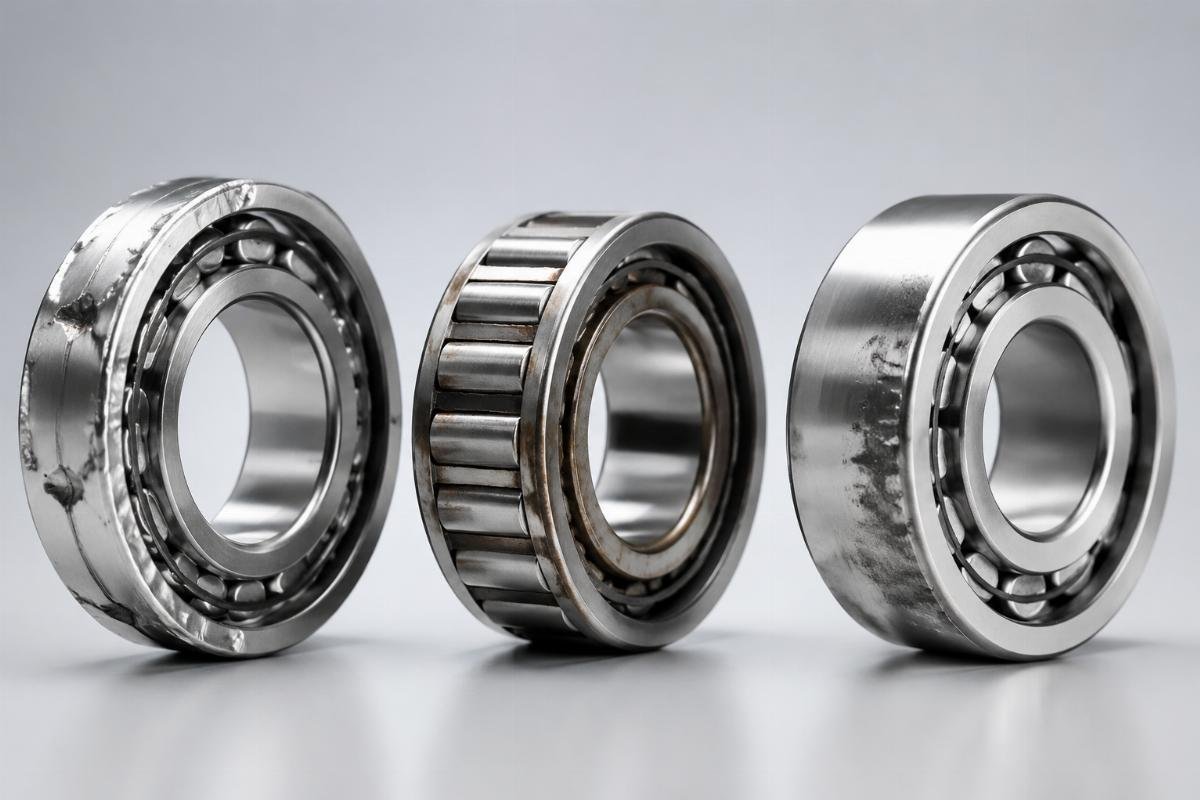
Common myths that lead to selection errors:
- Myth: "Roller bearings last longer in all heavy loads" – Reality: Spherical roller bearings fail faster in high-speed applications due to increased heat generation.
- Myth: "Tapered roller bearings are best for axial loads" – Reality: Angular contact ball bearings often outperform in combined high-speed axial applications.
- Myth: "Cylindrical roller bearings handle misalignment" – Reality: They require precise alignment; spherical rollers are better for misaligned shafts.
- Myth: "All roller bearings need the same clearance" – Reality: C3 and C4 clearance is critical for high-temperature or shock-load applications; CN clearance can cause seizure in kiln-line environments.
A South American mining operation ordered what they called "heavy-duty rollers" without specifying clearance or precision class. Standard CN clearance bearings were shipped, and they seized within weeks in a high-temperature kiln line. The lesson was clear: internal clearance codes must be verified against mill certificates on every batch, not assumed from the bearing type alone. [NEED_CITE: internal clearance selection for high-temperature industrial applications per SKF application engineering guidelines]
How to Verify Genuine Quality and Reduce Downtime?
Batch traceability, per-batch precision inspection, and correct clearance verification are non-negotiable for high-risk applications. As an authorized SKF distributor, every shipment we provide includes full batch traceability verifiable against SKF records, ensuring authenticity from factory to installation. For buyers in wind power, mining, steel mills, and petrochemical plants, counterfeit or mis-specified bearings are not a quality inconvenience—they are a safety and downtime risk. [NEED_CITE: bearing counterfeit detection and traceability standards per industry guidelines]
Our supply chain directly addresses the procurement pain points that ball vs roller bearings buyers encounter in the field:
- Batch Traceability – Every bearing shipped includes a certificate of origin and batch numbers verifiable against SKF records, eliminating counterfeit risk.
- Rapid Dispatch – Deep stock of rare designations, including large bore, special precision classes, ceramic, and stainless variants, ships within 48 hours versus typical factory lead times of 4 to 8 weeks.
- Precision Coverage – Full SKF industrial range from P0 to P4 precision classes, with clearance options C2, CN, C3, and C4 to match exact application requirements.
- Technical Support – L10 life calculation and failure analysis support help buyers validate selection before ordering.
For project suppliers and OEM factories, customization services include laser marking, private-label packaging, pre-lubrication, and translated documentation. Long-term supply agreements offer price predictability and priority allocation during market shortages. Payment terms include T/T, L/C, and DDP, CIF, or FOB options to match procurement workflows across different regions.
When buyers specify exact designations like SKF 22222 CCK/W33 or SKF 6309-2RS1/C3, they need confidence that what arrives matches the drawing. Per-batch precision inspection and third-party inspection on request provide that confidence. The difference between a bearing that lasts and one that fails early often comes down to whether the ball vs roller bearings supplier can prove what is in the box is genuine.
Conclusion
Selection errors, not product quality, cause the majority of premature bearing failures. Matching ball versus roller bearing types to actual operating conditions of load, speed, misalignment, and environment—then verifying every clearance code and batch number before shipment—directly determines equipment reliability and total cost of ownership. A ball vs roller bearings supplier who provides technical expertise, full traceability, and rapid access to rare designations ensures the right bearing reaches the right application the first time.